Best Law Firm Billing Software for UAE Law Firms: Features to Look For in 2026

Running a law firm involves much more than handling cases and advising clients. Behind every matter are hours of legal work, expenses, invoices, payments and financial records that need to be tracked carefully.
For many UAE law firms, billing can still involve spreadsheets, separate accounting tools and manual follow-ups. That approach may work for a small number of matters, but as a firm grows, it becomes harder to know what has been billed, what is still outstanding and how much time has actually been spent on each matter.
This is where law firm billing software can make a practical difference. The right system can bring time tracking, expenses, invoicing, payments and matter information together, making billing easier to manage and giving partners a clearer view of the firm's finances.
In 2026, UAE firms also have another consideration: the country's electronic invoicing programme is being introduced in phases. The UAE Ministry of Finance has confirmed that the pilot phase began in July 2026, with mandatory implementation scheduled in phases from 2027 depending on revenue and other requirements. So, what should a law firm look for when choosing billing software?
What Is Law Firm Billing Software?
Law firm billing software is designed to help legal practices manage the financial side of their work. Instead of treating billing as a separate activity, it connects invoices and payments with clients, lawyers and individual matters.
A typical billing process may look like this:
- A lawyer records time spent on a matter.
- Related expenses are added to the same matter.
- The system applies the appropriate billing rate or fee arrangement.
- Billable entries are reviewed.
- An invoice is prepared and sent to the client.
- Payments and outstanding balances are recorded.
- Partners or administrators can review billing reports.
This is different from using a general accounting system alone. Legal practices often need billing information to remain connected to specific clients and matters.
Why UAE Law Firms Need Better Billing Software in 2026
Manual billing can create small problems that eventually become expensive ones. A missed time entry, an unrecorded expense or a delayed invoice can affect the firm's revenue and cash flow. A dedicated legal billing software for law firms can help address these issues by providing a more structured billing process.
Reduce Missed Billable Hours
Lawyers often work across several matters in a single day. Recording time later from memory can result in incomplete or inaccurate entries.
A good system makes it easier to record time against the correct client and matter while the work is still fresh.
Improve Billing Accuracy
When calculations and invoice preparation are handled manually, errors can creep in. Centralising time, rates and expenses makes the review process more organised.
Keep Track of Outstanding Payments
Billing does not end when an invoice is sent. Firms also need to know which clients have paid, which invoices are overdue and how much remains outstanding. A good system provides this information without requiring someone to search through emails or spreadsheets.
Prepare for UAE eInvoicing
Electronic invoicing is becoming an important part of financial operations in the UAE. The Ministry of Finance states that an eInvoice is structured invoice data exchanged electronically; a PDF, Word document, image or scanned invoice does not qualify as an eInvoice.
The Ministry's current guidance sets out phased implementation, including mandatory implementation from January 2027 for businesses with annual revenue of AED 50 million or more and from July 2027 for businesses below AED 50 million, subject to the applicable rules.
For law firms, this makes it sensible to consider invoicing readiness when evaluating new software.
10 Features to Look for in Law Firm Billing Software
1. Lawyer and Staff Time Tracking
Time is one of the most important parts of legal billing.
Look for software that allows lawyers and staff to:
- Record time against individual matters
- Mark entries as billable or non-billable
- Review and edit time entries
- Track time by lawyer
- Submit entries for approval
The simpler time recording is, the less likely it is that billable work will be forgotten.
2. Matter-Based Billing
Billing should be connected to the legal matter rather than stored separately.
A useful system should allow firms to see:
- Client information
- Matter details
- Time recorded
- Expenses incurred
- Invoices issued
- Payments received
- Outstanding amounts
This gives lawyers and administrators a much clearer picture of the financial position of each matter.
3. Flexible Billing Options
Not every client is billed in the same way. Some matters may be billed hourly, while others may use fixed fees, retainers or recurring arrangements. When comparing law firm billing software, check whether it can support the firm's actual billing models rather than forcing every matter into one format.
4. Automated Legal Invoicing
Creating invoices manually can take considerable administrative time, particularly when a firm handles many clients.
Legal invoicing software in Dubai and elsewhere in the UAE should make it easier to:
- Generate invoices from recorded time
- Add expenses
- Use client and matter information
- Review invoices before sending
- Maintain invoice history
- Track invoice status
Automation does not mean removing human review. Instead, it reduces repetitive work while keeping the firm in control. By creating clearer and more consistent invoices, automation can also help reduce misunderstandings that may lead to client queries or billing disputes. Learn more about Reducing Billing Disputes with Automated Legal Invoicing
5. Client Billing and Payment Tracking
A strong client billing software for law firms should show the complete billing history of a client.
For example, administrators should be able to see:
- Invoices issued
- Payments received
- Outstanding balances
- Overdue invoices
- Billing history by matter
This makes payment follow-ups more organised and helps partners understand which accounts require attention.
6. Law Firm Expense Tracking
Legal matters often involve costs beyond lawyer fees. These may include filing fees, travel costs, expert charges and other matter-related expenses. Law firm expense tracking software should make it possible to record these expenses against the appropriate matter. That helps prevent expenses from being lost and makes it easier to identify which costs should be passed on to the client.
7. Accounting and Financial Reports
Billing software should give the firm useful financial information without making partners dig through multiple spreadsheets.
Depending on the system, useful reports may include:
- Revenue by client
- Revenue by matter
- Outstanding invoices
- Payment history
- Expense summaries
- Lawyer-wise billing
- Billing for a specific period
Firms searching for law firm accounting software UAE should also check whether a product provides full accounting functions or primarily handles billing and connects with an accounting system.
8. Integration With Law Firm Management Software
Billing should not sit in isolation from the rest of the firm's work.
A stronger approach is to connect billing with:
- Case management
- Client management
- Matter management
- Documents
- Tasks
- Time tracking
- Expenses
This is particularly useful when looking for law firm management software UAE that can support day-to-day legal operations as well as financial workflows.
9. Dashboards and Reporting
Partners should be able to answer basic questions quickly:
- How much has the firm billed?
- What remains unpaid?
- Which matters have generated the most revenue?
- How much has been spent on a matter?
- How much recorded work is still unbilled?
Clear reporting turns billing information into something useful for everyday decision-making.
10. Security and User Permissions
Billing systems contain sensitive client and financial information. Not every employee needs access to every record.
Look for features such as:
- User permissions
- Role-based access
- Activity records
- Secure data handling
- Backup processes
- Controlled access to financial information
The exact security features should always be checked against the provider's documentation.
How to Choose the Best Law Firm Billing Software in the UAE
There is no single system that will be the right choice for every firm. The best law firm billing software in UAE should fit the firm's size, billing methods and existing processes. Start by looking at how the firm works today.
Ask:
- How are lawyers recording their time?
- How are expenses captured?
- Who prepares invoices?
- Who approves them?
- How are overdue payments followed up?
- Where is billing information stored?
- Does the accounting team need to re-enter information manually?
Then consider UAE-specific requirements, including VAT-related invoicing processes and the country's eInvoicing programme. The Ministry of Finance has also encouraged businesses to prepare their systems, processes and governance ahead of implementation.
For a practical starting point, see these 3 tips for choosing law firm billing software, including time tracking, invoice management and payment considerations.
Beveron Smart Lawyer Office for UAE Law Firms
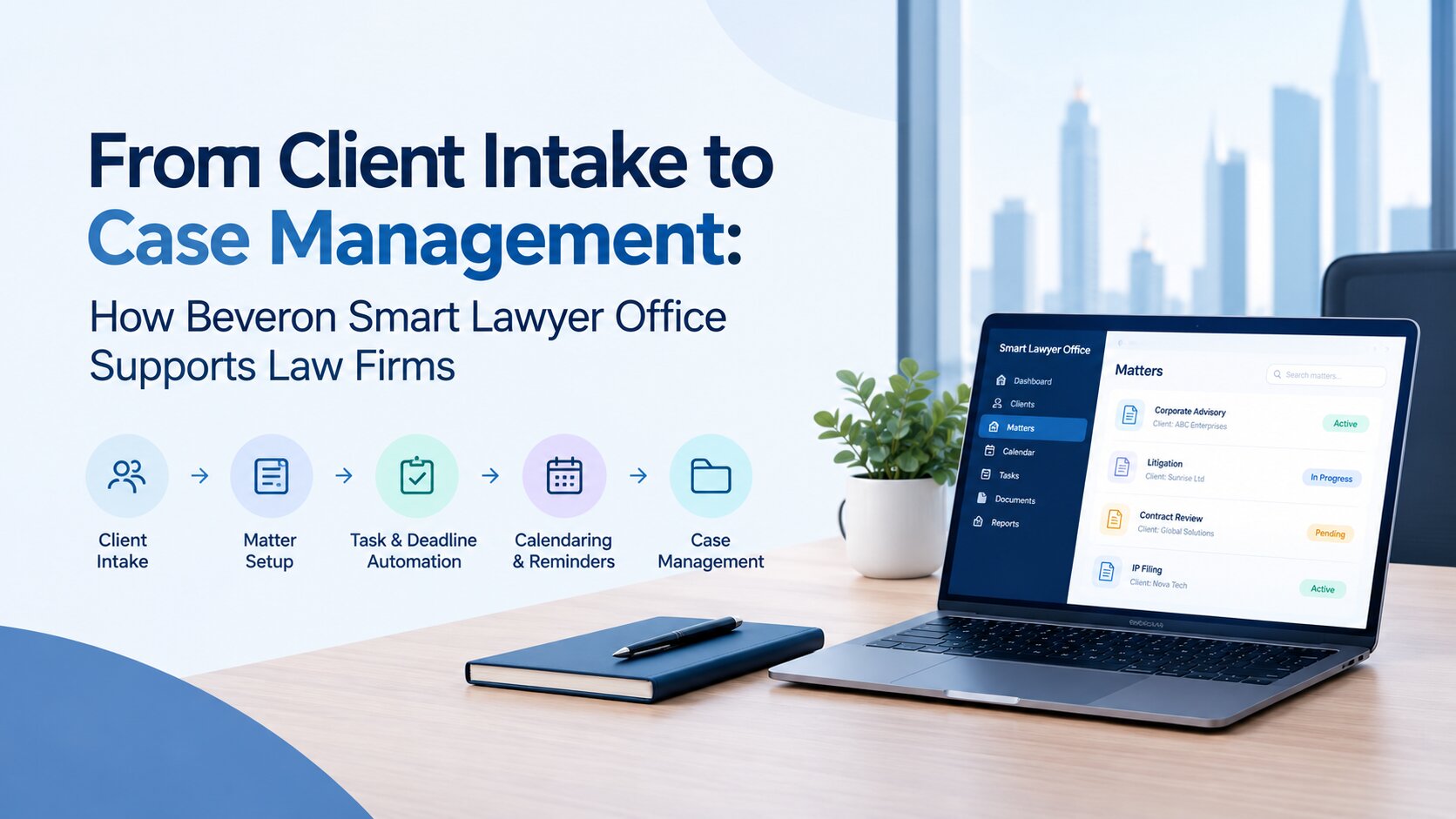
For firms looking beyond a standalone billing tool, Beveron Smart Lawyer Office takes a broader legal management approach. Instead of treating billing as a completely separate activity, an integrated legal management platform can connect financial information with the firm's wider legal work.
Smart Lawyer Office can help bring areas such as:
- Case and matter management
- Client management
- Legal workflows
- Documents
- Tasks
- Billing-related information
- Expenses
- Reporting
into a more organised environment. This matters because billing is closely connected to the work lawyers perform. When matter information, client records and financial information are scattered across different tools, teams may spend unnecessary time moving information from one place to another.
For UAE law firms, the goal should not simply be to find software that creates invoices. It should be to create a more connected workflow where legal work and billing information are easier to manage together.
Common Mistakes When Choosing Legal Billing Software
Choosing a Tool Only Because It Creates Invoices
Invoice generation is only one part of the billing process. Time, expenses, payments and reporting matter just as much.
Ignoring Integration
If lawyers use one system, administrators use spreadsheets and finance teams use another system, duplicate data entry can continue even after buying new software.
Overlooking Reporting
A system should make it easier to understand billing performance, not simply store invoices.
Choosing Software That Cannot Grow With the Firm
A solution that works for a small team may become restrictive as the number of lawyers, clients and matters increases.
Forgetting About Future UAE Requirements
With the UAE's eInvoicing rollout already underway, firms should consider whether their future billing setup can support changing invoicing requirements. The Ministry of Finance launched the 4-Corner eInvoicing model in April 2026 and has made accredited service providers available through the UAE's digital tax ecosystem.
Final Checklist
Before choosing law firm billing software, check whether it can:
- Track lawyer and staff time
- Connect billing with clients and matters
- Support different fee arrangements
- Track legal expenses
- Generate and manage invoices
- Track payments and outstanding balances
- Provide useful financial reports
- Connect with wider law firm management workflows
- Support relevant UAE invoicing requirements
- Provide appropriate user permissions and security
- Scale as the firm grows
Conclusion
The best legal billing software in UAE is not necessarily the platform with the longest feature list. It is the one that fits the firm's actual workflow and makes billing easier to manage. For UAE law firms, that means looking beyond invoice creation. Time tracking, matter-based billing, expense management, payment tracking, reporting and integration all play a role.
The UAE's move towards electronic invoicing also makes it important to think about where billing systems are heading, rather than choosing software based only on today's needs.
For firms looking for a broader approach, Beveron Smart Lawyer Office can provide a way to bring legal operations and billing-related workflows into a more connected environment. The right system can reduce administrative effort, improve visibility and give legal teams more time to focus on the work that matters most: serving their clients.
Best law firm billing software in the UAE
Best law office billing software in the UAE
Best legal billing software for law firms in the UAE
If you need a free demo of the best law firm billing software in the UAE, please fill out the form below.