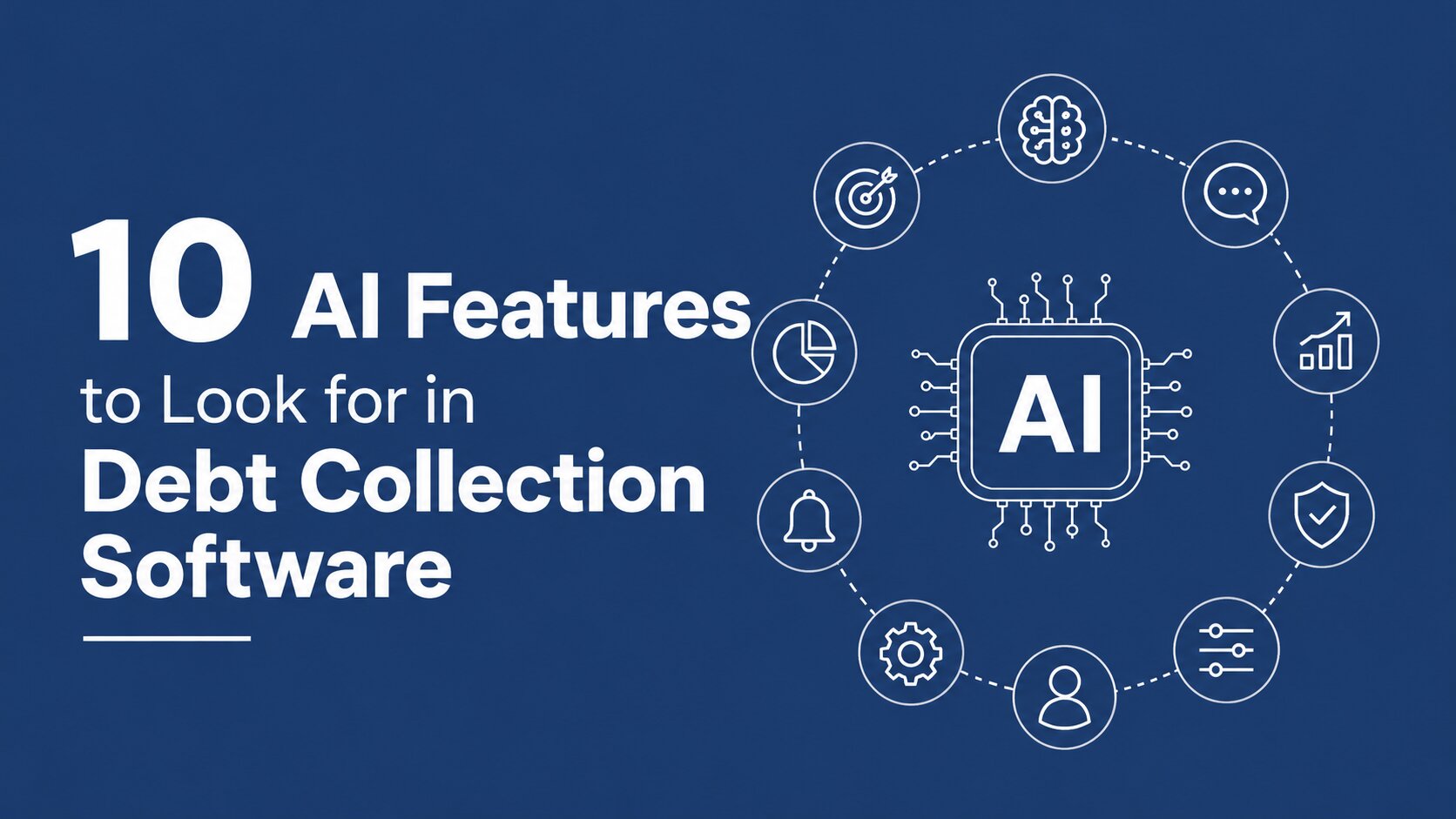
10 AI Features to Look for in Debt Collection Software
Managing overdue accounts is not just about sending payment reminders. Collection teams need to understand payment behaviour, decide which accounts require attention, communicate with customers and keep track of every action taken. As the number of accounts grows, handling these tasks manually can become difficult and time-consuming.
Artificial intelligence (AI) is changing how businesses approach debt collection by helping teams analyse account information, identify patterns and make better-informed decisions. However, not every software solution offers the same capabilities, and not every task requires AI.
When evaluating debt collection software, businesses should look beyond general claims about AI and focus on features that address their actual collection challenges. Here are ten AI capabilities worth considering, along with practical points to assess before choosing a solution.
10 AI Features to Look for in Debt Collection Software
1. Predictive Analytics for Account Prioritisation
Collection teams often manage hundreds or thousands of overdue accounts, but not every account requires the same level of attention. Predictive analytics can help identify which accounts may need earlier intervention by analysing historical payment records, overdue periods and other relevant account information.
For example, a business may use these insights to distinguish between customers who regularly make late payments but eventually settle their balances and accounts that show a different pattern of payment behaviour. This can help collectors plan their workload and focus their efforts more effectively. When evaluating this feature, ask how the software produces its predictions, what data it uses and how its accuracy is assessed. Predictions should support collection decisions rather than determine them automatically, particularly when decisions could significantly affect customers.
2. Customer Segmentation Based on Payment Behaviour
A single collection approach rarely works for every customer. Some customers may need a simple reminder, while others may require a discussion about repayment options or further action on a long-overdue account. AI-based customer segmentation can analyse payment histories, outstanding balances, delinquency patterns and previous interactions to identify groups with similar characteristics. Collection teams can then use these insights to develop more suitable communication and follow-up strategies.
For instance, customers with a history of settling balances shortly after receiving reminders may be handled differently from accounts that have remained unpaid for several months. The aim is to help teams choose appropriate next steps instead of treating every overdue account in exactly the same way. Businesses should check whether segmentation rules can be reviewed and adjusted, and whether the system avoids relying on inaccurate or unfair assumptions about customers.
3. Personalised Collection Messages
Generic payment reminders may not always address a customer's situation. AI can help collection teams prepare more relevant messages using information such as the outstanding balance, payment due date, previous communications and account status. For example, a reminder about an approaching payment deadline may need different wording from a message concerning an account that has remained overdue despite several reminders. AI-assisted writing tools can help adapt the message while keeping the essential information consistent.
Personalisation should not mean sending more messages without considering their purpose. Businesses should be able to review communications, maintain an appropriate tone and ensure that messages follow applicable collection and data protection requirements. When evaluating this capability, check whether the software supports the communication channels your customers use and whether staff can approve or edit AI-generated messages before sending them.
4. Intelligent Follow-Up Recommendations
Keeping track of when to contact customers and what action to take next can be challenging, particularly when collectors manage large portfolios. AI can analyse account history and previous interactions to recommend suitable follow-up actions.
For example, the system might suggest reviewing an account after a missed payment commitment or bringing a repeatedly overdue account to a supervisor's attention. These recommendations can help collectors organise their work and reduce the likelihood of important accounts being overlooked.
It is important to distinguish between AI-based recommendations and conventional workflow automation. Traditional automation follows predefined rules, such as sending a reminder three days after a missed payment. AI may go further by identifying patterns and suggesting an action based on the available information. A useful system should allow collection managers to define business rules, review recommendations and retain control over escalation decisions.
5. Payment Pattern Analysis
A customer's payment history can reveal useful information about how an account is progressing. AI can analyse past transactions and account records to identify recurring late payments, changes in payment frequency and other patterns that may deserve attention.
For example, an account that previously received regular payments but has recently stopped showing activity may need a different follow-up approach. Similarly, recurring delays around payment dates may help a collection team decide when a reminder is most relevant.
These insights can help teams respond to changing account circumstances rather than relying only on the number of days an invoice has remained unpaid. However, payment patterns do not always explain why a customer has missed a payment. Businesses should treat the findings as indicators for further review, not as proof of a customer's financial circumstances or intentions.
6. Repayment Plan Recommendations
When customers cannot settle their outstanding balances in full, a repayment plan may provide a practical way forward. AI can help analyse account balances, payment histories and other permitted information to support the assessment of possible repayment options.
For example, a collection team may use available account information to review whether an instalment-based arrangement is worth considering. The final terms should still follow the organisation's policies, contractual obligations and applicable requirements.
This feature is particularly relevant for businesses managing large numbers of accounts, where reviewing each case individually can take considerable time. Data-driven recommendations may help staff assess cases more consistently, provided the information is accurate and the system's limitations are understood. Before choosing software, ask whether repayment recommendations can be reviewed by authorised staff, whether agreed payment terms can be tracked and whether the system records changes to repayment arrangements.
7. Document and Data Extraction
Debt collection involves handling account statements, payment records, correspondence, agreements and other documents. Manually reviewing and entering information from these sources can slow down collection work and increase the risk of errors. AI-based document processing can extract relevant information from supported documents and help transfer it into structured records. Depending on the software, this may include account references, dates, balances and other details needed to manage a collection case.
For example, a team receiving a large number of account documents may be able to reduce manual data entry by using document extraction, followed by checks to confirm that the information has been captured correctly. When assessing this capability, look at the document formats supported, the accuracy of extracted information and the process for correcting mistakes. Sensitive financial information should also be handled through appropriate access controls and data protection measures.
8. Conversation Analysis
Collection teams communicate with customers through calls, emails, messages and other channels. Reviewing these interactions can help businesses understand recurring concerns, identify unresolved disputes and recognise where communication needs improvement. AI can analyse permitted conversation records to identify common topics, repeated objections and changes in the tone of an interaction. For example, it may help a manager identify accounts where customers have raised questions about payment amounts or disputed a charge.
These insights can support staff training and help teams decide which cases need further attention. They may also reduce the time managers spend manually reviewing large volumes of conversations. Businesses should confirm which channels the software can analyse and what recording, consent, privacy and retention requirements apply. AI-generated interpretations should be checked carefully, as tone and context can be misunderstood.
9. Unusual Activity and Risk Detection
Inconsistent account information and unexpected payment patterns can create problems for collection teams. AI can help flag unusual activity by comparing account records and identifying changes that differ from established patterns.
For example, a system might highlight conflicting account details, an unexpected change in payment activity or records that require verification. These alerts can help staff investigate potential errors, unusual transactions or other concerns before proceeding with further collection action.
The usefulness of this feature depends on the quality of the underlying data and the ability to distinguish meaningful issues from ordinary variations. Too many inaccurate alerts can create additional work rather than reduce it. When evaluating software, ask how alerts are generated, whether staff can investigate the reasons behind them and how the system handles false alerts. Any significant action should follow the organisation's review procedures.
10. Collection Performance Insights
Collection managers need a clear picture of how their teams and portfolios are performing. AI-supported analytics can help identify changes in collection trends, differences in recovery performance and areas where existing strategies may need attention.
For example, managers may examine whether recovery rates are changing across ageing categories, whether certain types of accounts require more follow-up effort or whether particular collection approaches are producing better results. These insights can support more informed decisions about workload allocation and collection processes.
It is important to distinguish useful analysis from attractive dashboards that provide little practical value. The software should present accurate information that managers can use to understand what is happening and decide what to do next.
Before choosing a solution, check whether it offers the reports your business needs, allows performance to be measured over time and supports the collection indicators that matter to your organisation.
Beyond individual software features, AI is also changing how collection teams approach recovery strategies. Read our article on AI in Debt Collection: 6 Powerful Applications Transforming Recovery in 2026 for a closer look at these applications.
How to Choose AI Debt Collection Software
The right software should address real collection problems rather than simply offer a long list of AI features. Before making a decision, businesses should consider how well the platform fits their existing operations and whether its capabilities can be evaluated in practice.
Data accuracy and transparency are essential. AI recommendations are only as useful as the information behind them. Ask the provider what data the system uses, how recommendations can be reviewed and how errors are corrected. Staff should be able to understand when an AI-generated suggestion needs further investigation.
Integration with existing systems is another important consideration. Debt collection teams may already use accounting software, customer relationship management systems, enterprise resource planning platforms and payment services. A suitable solution should support the integrations or data-import methods required to reduce duplicate entry and keep records consistent.
Security and compliance should also be part of the evaluation. Businesses operating in the UAE and Saudi Arabia need to consider the data protection, financial and collection requirements applicable to their activities. Review access controls, audit records, data handling arrangements and any relevant rules governing customer communication and AI use.
Finally, consider how the business will measure the results. Changes in recovery rates, time spent on manual tasks, missed follow-ups and collection costs can help determine whether the software is delivering value. Establish a baseline before implementation and assess results over time rather than assuming that introducing AI will automatically improve performance.
Managing Debt Collection with Beveron Smart Debt Collection
AI capabilities are only one part of an effective debt collection operation. Teams also need reliable ways to manage debtor records, organise follow-ups, track payment commitments and monitor recovery performance.
Beveron Technologies' Smart Debt Collection is designed to help businesses organise these activities through a central platform. It supports the management of debtor information, payment plans, promise-to-pay commitments, collection workflows and communication through supported channels such as SMS, WhatsApp and email.
The platform also supports collection-related processes such as litigation tracking, court-judgement management, ageing analysis and agent performance reporting. Data-import options and integration capabilities can help businesses connect collection activities with their wider operations, depending on their requirements and the integrations available.
For banks, non-banking financial companies (NBFCs), debt collection agencies and corporate finance teams, having these activities organised in one system can make it easier to track account progress and maintain visibility over ongoing work.
When evaluating Beveron Smart Debt Collection or any other platform, businesses should assess the available features against their specific requirements. If AI-based prediction, document extraction or conversation analysis is a priority, confirm whether those capabilities are currently available and how they would work with your existing processes.
Explore Beveron Smart Debt Collection to learn more about its collection management capabilities and discuss your business requirements with the team.
Frequently Asked Questions
What is AI-powered debt collection software?
AI-powered debt collection software uses artificial intelligence to analyse account information, identify patterns and support collection decisions. Depending on its capabilities, it may help prioritise overdue accounts, prepare personalised messages, analyse payment behaviour and identify unusual activity. The specific features available vary by provider.
Can AI improve debt recovery rates?
AI may help improve collection decisions by identifying accounts that need attention, supporting timely follow-ups and revealing useful payment patterns. However, better recovery is not guaranteed. Results depend on data quality, customer circumstances, collection practices and how effectively the software is used.
How does AI identify which overdue accounts to prioritise?
AI-based systems can analyse information such as payment history, outstanding balances and previous collection activity to estimate which accounts may need attention. Collection teams can use these insights alongside account-specific information, company policies and staff judgement to determine the next steps.
Is AI debt collection software suitable for banks and collection agencies?
It can be suitable for banks, NBFCs, debt collection agencies and other businesses that manage overdue accounts. The right solution depends on portfolio size, collection workflows, reporting needs, integration requirements, security and applicable regulations.
What is the difference between AI and automated debt collection?
Traditional automation performs tasks according to predefined rules, such as sending reminders after a missed payment. AI can analyse data to identify patterns, make predictions or suggest actions. Some debt collection platforms combine both approaches, using automation to carry out routine tasks and AI to support more informed decisions.
Choose AI Features That Fit Your Collection Needs
AI can help collection teams make better use of account information, identify patterns and decide where to focus their efforts. However, the most useful features are those that address specific business challenges, work with reliable data and support responsible collection practices.
Before selecting debt collection software, consider which tasks take the most time, where important follow-ups are missed and which insights would help your team make better decisions. Then assess each provider against those needs, verify its actual AI capabilities and look for measurable results.
Beveron Smart Debt Collection offers tools to manage collection workflows, payment commitments, debtor records and performance reporting in one platform.
Book a demo to explore how its collection management features could fit your organisation's requirements.
Best AI-powered debt collection software for banks in the UAE
Best debt collection management software for finance teams in the UAE
Best AI debt recovery software in the UAE
If you need a free demo of the best in-house legal counsel software in Kenya, please fill out the form.