How Do You Manage Beneficiary Tracing at Scale?
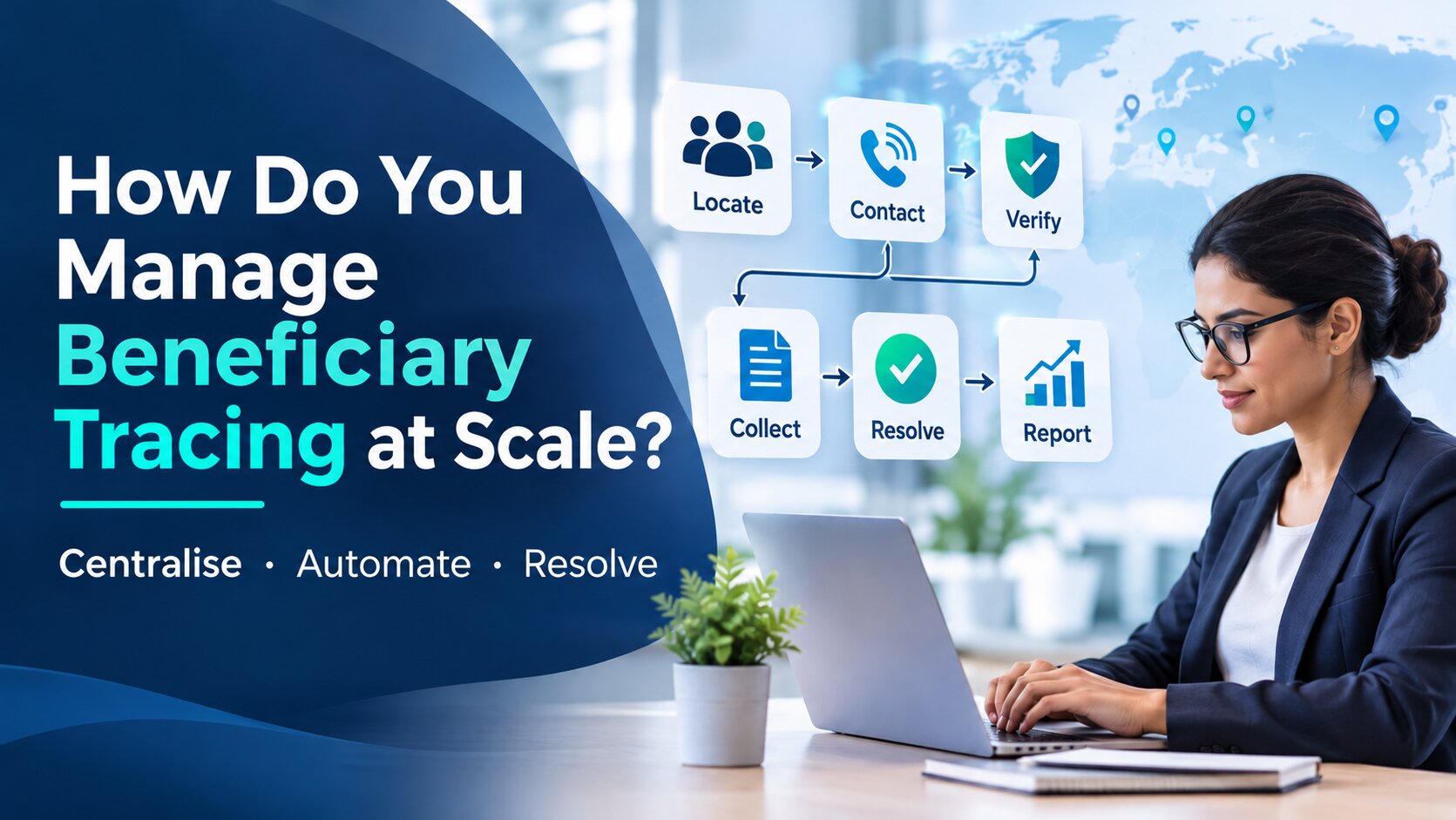
Managing beneficiary tracing at scale requires more than maintaining a large database of names and contact details. Organisations need a structured way to collect information, identify potential contact points, coordinate tracing activities, verify identities and monitor progress. They also need clear visibility into which cases are progressing, which require additional attention and which have reached resolution. A combination of organised data, consistent workflows and suitable technology can help teams manage these activities more effectively while maintaining control over large tracing portfolios.
Why Does Beneficiary Tracing Become Difficult at Scale?
The main challenge in large-scale beneficiary tracing is not simply the number of records involved. It is the amount of information that teams must collect, verify and update throughout the process. A single case may involve several contact attempts, supporting documents, identity checks and follow-up activities. When these requirements multiply across thousands of cases, manual coordination becomes difficult to maintain.
Outdated contact information is one of the most common obstacles. Beneficiaries may have changed their phone numbers, email addresses or residential locations over time. Organisations working with older records may find that the information available is no longer sufficient to establish contact. Teams then need to identify alternative contact details and determine whether those details are still valid.
Another challenge is scattered beneficiary information. Contact details, identification documents, communication records and case updates may be stored across spreadsheets, emails and different internal systems. When information is spread across multiple sources, employees spend valuable time searching for records instead of progressing cases. It can also become difficult to determine whether another team member has already contacted the beneficiary or requested the same documents.
Repeated manual follow-ups add to the workload. Without a clear record of previous communication, employees may contact the same individual multiple times or miss important follow-up dates. Similarly, cases requiring identity verification or additional documentation can remain pending because there is no clear process for tracking outstanding requirements.
As the number of cases increases, limited visibility into case progress becomes another concern. Managers need to understand how many beneficiaries have been located, how many are awaiting verification and how many cases remain unresolved. If these updates depend on manually prepared reports, it becomes harder to identify delays and distribute work effectively.
How Can Organisations Manage Beneficiary Tracing More Effectively?
An effective beneficiary tracing operation needs a consistent process that can be applied across different case volumes. Rather than treating each assignment as a separate activity, organisations should establish clear procedures for managing information, communication, verification and resolution. This helps employees understand what needs to be done at each stage and gives managers a better view of overall progress.
1. Centralise Beneficiary Information
The first step is to bring beneficiary information into one organised system. Maintaining separate spreadsheets or individual records for every tracing assignment may work initially, but it becomes increasingly difficult to manage as the portfolio grows. A centralised record allows employees to access relevant information without searching through multiple files or relying on updates from other team members.
Each beneficiary profile should contain available personal details, identification information, contact numbers, email addresses, residential details and relevant supporting documents. It should also include a history of previous tracing attempts, communication outcomes and verification activities. This gives employees a clearer understanding of the case before taking further action.
Organisations should also establish a process for identifying duplicate records and incomplete information. For example, the same beneficiary may appear under slightly different names or with different contact details in records received from multiple sources. Identifying these inconsistencies early can prevent duplicated work and improve the quality of the tracing database.
2. Improve Contact Discovery and Tracking
Locating a beneficiary often requires more than one contact detail. An individual may no longer use a registered phone number but may still be reachable through an alternative email address, residential address or other available contact information. For this reason, organisations should maintain multiple contact points wherever reliable information is available.
However, collecting additional details is only part of the process. Teams must also understand where the information came from, when it was obtained and whether it has been verified. A contact number received from an old record should not automatically be treated as current. Recording the source and status of each contact detail helps employees make better decisions about the next tracing attempt.
It is equally important to maintain a history of contact discovery activities. When one employee identifies a new contact number, other authorised team members should be able to access that update rather than repeat the same search. This creates continuity across the tracing operation and reduces unnecessary effort.
3. Establish a Consistent Communication Process
Once potential contact details have been identified, organisations need a clear approach to communicating with beneficiaries. Depending on the available information and the nature of the assignment, communication may take place through phone calls, SMS, WhatsApp or email. Using different channels can improve the chances of establishing contact, provided that communication is appropriate, authorised and handled in accordance with applicable privacy requirements.
Every communication attempt should be recorded with its date, channel and outcome. For instance, a phone call may go unanswered, an email may be delivered without a response, or a beneficiary may request additional information before proceeding. Recording these outcomes helps employees understand what has already happened and decide how to proceed.
A structured communication process also makes follow-ups easier to manage. Instead of relying on individual employees to remember when they last contacted someone, organisations can establish follow-up schedules and assign responsibility for pending communication. This helps maintain consistency across large portfolios without creating unnecessary repeated contact.
4. Prioritise Cases Based on Traceability
Not every beneficiary tracing case requires the same amount of effort or attention. Some records may contain several valid contact details and complete identification information, while others may have limited or outdated records. Treating all cases equally can make it difficult to allocate available resources effectively.
Organisations can improve case management by assessing the information available for each beneficiary. Factors such as the quality of contact details, completeness of identification records, previous communication outcomes and outstanding verification requirements can help teams understand which cases need attention first.
For example, a case with a recently verified phone number and complete supporting information may be ready for the next stage, while another case with missing contact details may require additional investigation. This does not mean that less traceable cases should be ignored. Instead, prioritisation helps teams plan their workload, identify cases requiring specialist attention and allocate resources more appropriately.
Managers should also consider employee workloads, geographical coverage and language requirements when assigning tracing activities. A clear allocation process reduces confusion and makes it easier to monitor individual responsibilities.
5. Automate Follow-ups and Case Progression
When employees manage a large number of cases, remembering every pending activity becomes difficult. A missed follow-up or an unassigned task can delay an otherwise straightforward tracing process. Automation helps organisations reduce their dependence on manual reminders and individual tracking methods.
For example, a system can create follow-up tasks when a beneficiary does not respond within a specified period. It can also notify the responsible employee when documents are pending, a verification activity is incomplete or a case has remained unresolved beyond its expected timeline. Supervisors can receive notifications when cases require escalation or additional attention.
Automation is particularly useful when different stages of a tracing assignment involve different employees or departments. Once one activity is completed, the case can move to the next stage according to the organisation's defined workflow. This makes responsibilities clearer and reduces the need for employees to coordinate every update manually.
The objective is not to remove human involvement from beneficiary tracing. Employees still need to review information, communicate with beneficiaries and make decisions about individual cases. Automation simply helps ensure that routine activities are tracked and that important actions are not overlooked.
6. Standardise Identity Verification and Document Collection
Establishing contact with a beneficiary does not necessarily mean that the case is ready for resolution. Organisations may still need to confirm the individual's identity, establish the relevant beneficiary relationship and collect supporting documents before proceeding. These requirements can vary depending on the organisation, the nature of the case and applicable regulations.
A standardised verification process helps employees understand which information and documents are required. Depending on the assignment, this may include identity documents, proof of address, employment details, banking information or documents establishing a relationship with the original account holder. Each requirement should be recorded so that employees can distinguish between completed, pending and rejected submissions.
Document tracking is equally important. When beneficiaries submit information through different channels, teams need a reliable way to associate each document with the correct case. They should also be able to record whether the document has been received, reviewed, approved or returned for additional information.
Keeping verification and document collection within the same case workflow helps prevent information gaps. It also makes it easier for authorised employees to understand why a case is still pending and what needs to happen before it can move towards resolution.
How Does Technology Improve Beneficiary Tracing at Scale?
As tracing operations grow, organisations need technology that can support the entire process rather than simply store beneficiary information. A basic database may help maintain records, but it does not necessarily provide the tools needed to manage contact attempts, verification activities, document collection and case resolution. A dedicated beneficiary tracing platform brings these activities together, allowing teams to work from a shared record and follow a consistent process. This is particularly important when managing complex beneficiary tracing cases, where multiple contact attempts, verification requirements and documentation need to be coordinated.
One important capability is centralised case management. Each beneficiary should have an individual profile containing personal information, contact details, related records, communication history, verification status and resolution updates. This prevents information from being scattered across different systems and gives employees a complete view of the case before taking further action.
Workflow automation also makes a difference when managing large portfolios. Automated task assignments, reminders, follow-ups and escalation notifications help employees stay on top of their responsibilities. Managers can identify cases that have not progressed and take action before delays affect the overall operation.
Another useful capability is intelligent case prioritisation. Instead of assigning cases randomly, organisations can use available information, such as contact quality, identification details and previous tracing outcomes, to determine which cases may be easier to progress. This helps managers distribute work according to case requirements and employee availability.
AI-assisted features can further support employees by summarising lengthy case histories, identifying missing information and suggesting possible next actions. These capabilities can reduce the time spent reviewing individual records, although important decisions, identity verification and final case approvals should remain under human supervision.
Finally, reporting and dashboards give managers a clearer picture of operational performance. They can review the number of active cases, successful contact attempts, completed verifications, pending documents and resolved assignments. With this information available in one place, organisations can identify bottlenecks and make more informed decisions about resource allocation.
How Do You Measure the Performance of a Beneficiary Tracing Operation?
Managing a large tracing portfolio requires more than knowing how many beneficiaries have been contacted. Organisations need to understand whether their tracing activities are producing meaningful results and how long it takes for cases to progress from initial assignment to final resolution.
One important measure is the contact establishment rate, which indicates how many beneficiaries have been successfully reached compared with the total number of cases where contact was attempted. This helps teams assess whether their contact information and communication methods are effective.
The identity verification completion rate shows how many beneficiaries have completed the required identity and information checks. Similarly, the document collection rate helps organisations understand whether beneficiaries are submitting the supporting information needed to progress their cases.
Another important measure is the successful case resolution rate. Finding a beneficiary does not necessarily mean that the assignment is complete. A case may still require identity confirmation, document review, quality checks and formal acceptance. Measuring final resolutions provides a more meaningful view of tracing performance than simply counting successful contact attempts.
Organisations should also monitor the average time taken to establish contact and resolve a case, along with pending and overdue assignments. These figures help managers identify where delays are occurring and whether additional resources or process changes are required. Agent productivity and service-level agreement (SLA) compliance are equally useful. They help managers understand how workloads are distributed, whether assigned activities are being completed within expected timelines and where additional support may be needed.
Together, these measures provide a more complete understanding of tracing performance. They also help organisations identify recurring problems, improve internal processes and maintain clearer accountability across large assignments.
How Does Beveron Support Large-Scale Beneficiary Tracing and Resolution?
For organisations managing hundreds or thousands of beneficiary records, maintaining separate spreadsheets, communication logs and verification documents can make the tracing process difficult to control. Beveron's Beneficiary Tracing and Resolution Software brings these activities together in one platform, helping pension funds, fund administrators, insurance companies, banks, government programmes and professional tracing agencies manage the complete tracing lifecycle.
The platform follows a structured process covering data intake, beneficiary identification, contact, verification, document collection, resolution and reporting. Rather than treating each activity as a separate task, it connects them through individual beneficiary records, allowing employees to access the relevant information and case history throughout the process.
Bulk Beneficiary Data Import allows organisations to upload records through Excel, CSV or API integrations. The platform supports field mapping, data validation, duplicate detection and import error reporting. This helps teams process large assignments without manually creating individual records for every beneficiary.
Through its Beneficiary 360 Profile, employees can access personal information, identification details, employment records, multiple contact details, communication history, verification information, documents, follow-ups and resolution history from a single screen. This makes it easier to understand the current status of a case before proceeding with another tracing activity.
The platform also includes Smart Contact Intelligence, which helps teams manage multiple contact points associated with each beneficiary. Phone numbers, email addresses and other contact details can be classified according to their status, such as discovered, attempted, verified, invalid or historical. Information such as the source, date discovered, previous attempts and contact outcome is also maintained, helping employees avoid repeating unsuccessful activities.
For organisations handling large assignments, the Traceability Score helps prioritise cases based on factors such as identification availability, contact-data quality, information recency and previous contact success. Cases can also be allocated using configurable rules covering agent workload, geographical region, language, priority, service-level requirements and employee skills. Supervisors retain the ability to reassign cases manually or in bulk when operational priorities change.
Beveron's workflow automation supports follow-up dates, task assignments, reminders, escalations and service-level alerts. When a beneficiary does not respond, the system can schedule another contact attempt. When documents are received, the case can move to the next stage for review and quality checks. This helps employees manage their daily workload without depending entirely on manual tracking.
The platform supports communication through calls, SMS, email and WhatsApp, with interactions recorded in the relevant tracing history. It also provides structured identity and beneficiary verification across areas such as personal identity, contact information, employment, banking and beneficiary relationships. Supporting documents can be tracked from the initial request through receipt, review and verification.
AI-assisted capabilities further support tracing teams by summarising complex case histories, identifying data-quality issues, searching beneficiary portfolios using natural-language questions and suggesting possible next actions. Employees remain responsible for reviewing information and approving important case decisions.
Once cases progress towards completion, management dashboards and reports provide visibility into tracing status, contact attempts, verification progress, document completion, resolution rates, average resolution time and agent productivity. Organisations managing multiple clients, funds or assignments can also monitor their portfolios separately.
With these capabilities, Beveron helps organisations move beyond basic beneficiary searches towards a more structured and measurable resolution process. If your organisation manages high volumes of beneficiary records and needs better control over tracing activities, request a demo of Beveron's Beneficiary Tracing and Resolution Software to understand how the platform can support your operations.
What Should Organisations Look for in a Beneficiary Tracing Platform?
Choosing a beneficiary tracing platform requires an understanding of how the organisation currently manages its tracing activities and where the main operational difficulties occur. A system that only stores names and contact numbers may not be sufficient for organisations handling large assignments with multiple verification and documentation requirements. When selecting a platform, organisations should consider important factors such as workflow flexibility, data management, automation and reporting capabilities to ensure they are evaluating beneficiary tracing software for better results.
The platform should support bulk data imports and provide a centralised profile for each beneficiary. It should also maintain a clear history of contact attempts, discovered information and verification activities so that employees can continue work without repeating previous efforts.
Workflow flexibility is another important consideration. Different clients, funds and tracing assignments may have different communication procedures, document requirements and resolution stages. Organisations should look for a platform that can accommodate these differences without requiring employees to maintain separate manual processes.
It is also important to consider automated follow-ups, case allocation, reporting and performance tracking. These capabilities help managers maintain visibility over large portfolios and understand where cases require additional attention.
Finally, because beneficiary tracing involves sensitive personal information, organisations should evaluate access permissions, data protection controls, consent records and audit trails. The right platform should support both operational efficiency and responsible information management.
Manage Beneficiary Tracing More Effectively with Beveron Smart Tracing
Managing thousands of beneficiary records does not have to mean handling endless spreadsheets, manual follow-ups and disconnected verification activities. With Beveron Smart Tracing, organisations can bring beneficiary information, contact tracking, identity verification, document collection and case resolution together in one platform. From bulk data imports and intelligent case allocation to automated workflows and performance reporting, the platform helps tracing teams manage large portfolios with greater visibility and control.
Looking to improve your beneficiary tracing operations? Request a demo of Beveron Smart Tracing and explore how it can support your organisation's tracing and resolution requirements.
Frequently Asked Questions
1. What is beneficiary tracing, and why is it important?
Beneficiary tracing is the process of locating and establishing contact with individuals who may be entitled to benefits, payments, claims or other financial assets but whose current contact information is unavailable or outdated. It is important because organisations need to identify the rightful beneficiaries, verify their information, collect supporting documents and complete the necessary steps before releasing benefits or resolving outstanding claims.
2. How can organisations trace thousands of beneficiaries efficiently?
Organisations can manage large tracing assignments by centralising beneficiary records, using bulk data imports, maintaining multiple contact points and establishing consistent communication and verification procedures. Automated task assignments, follow-up reminders and case prioritisation can further reduce manual work. A dedicated beneficiary tracing platform also helps teams monitor progress and manage the entire process from one place.
3. How do you manage outdated beneficiary contact information?
Outdated contact information can be managed by reviewing existing records, identifying alternative contact details and using authorised data-enrichment sources where appropriate. Organisations should record the source and verification status of each contact point, maintain previous communication outcomes and update beneficiary profiles whenever new information becomes available. This helps employees avoid relying on invalid details or repeating unsuccessful contact attempts.
4. How does automation improve beneficiary tracing operations?
Automation helps manage routine activities such as case assignments, follow-up scheduling, reminders, document requests and escalations. It reduces dependence on manual tracking and helps employees identify pending tasks. Managers can also use automated reporting to monitor case progress, identify delays and understand overall tracing performance.
5. What features should beneficiary tracing software include?
Beneficiary tracing software should include bulk data import, centralised beneficiary profiles, contact information management, communication tracking, identity verification, document collection, workflow automation and case allocation. Reporting dashboards, AI-assisted case management, data-quality checks and access controls are also valuable for organisations managing large tracing portfolios.
Best beneficiary tracing software for banks
Best beneficiary resolution software for insurance companies
Best beneficiary tracing management for professional tracing agencies
If you need a free demo of the best beneficiary tracing software for banks , please fill out the form.