AI-Powered Compliance Monitoring: How Legal Teams Can Detect Risks Earlier
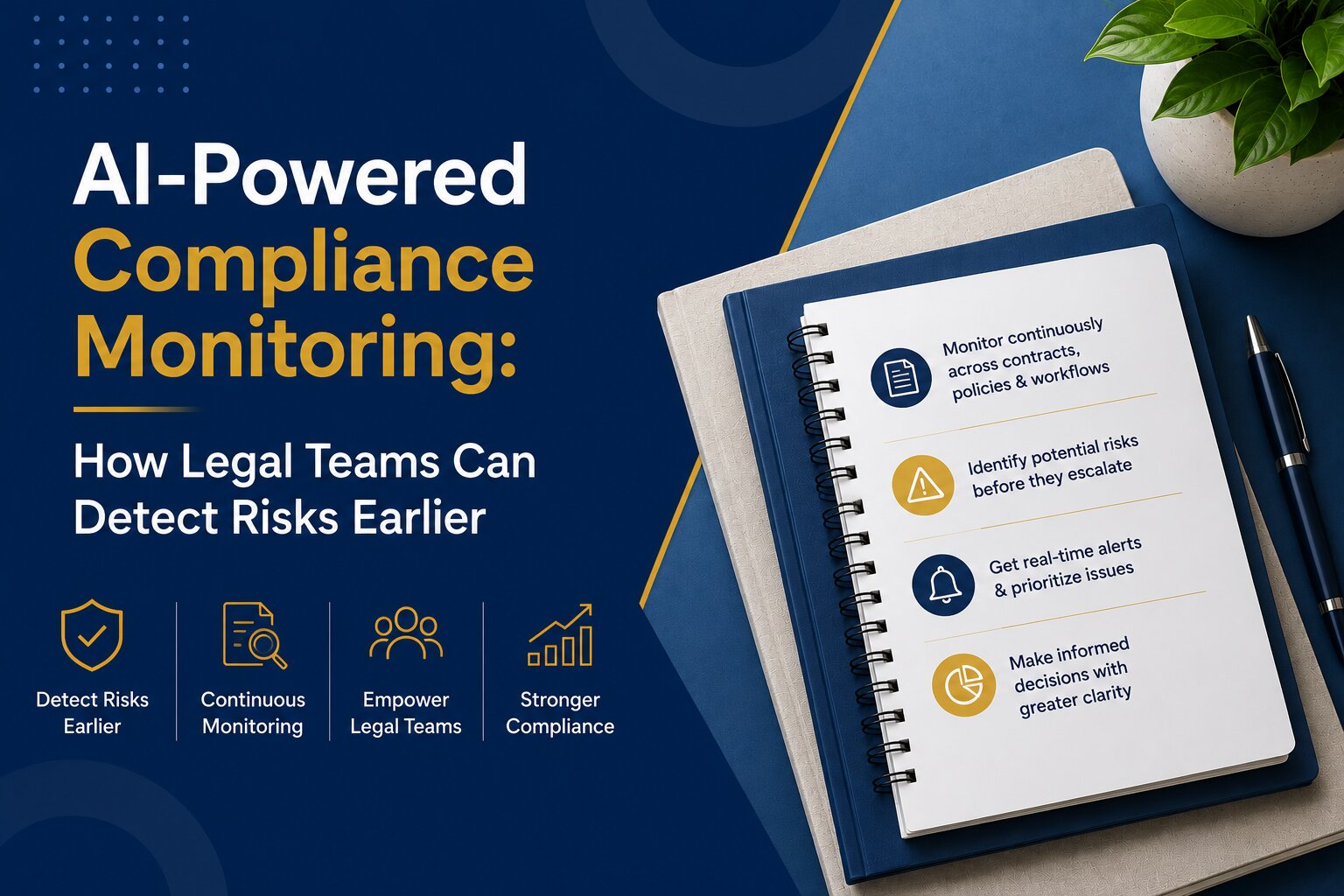
AI-powered compliance monitoring uses artificial intelligence to continuously analyse legal documents, policies, workflows, and regulatory data to identify compliance risks before they become serious issues. Unlike traditional compliance reviews, which rely on periodic audits, AI provides real-time monitoring, early risk detection, automated alerts, and actionable insights. This enables legal teams to reduce manual effort, strengthen governance, and respond to compliance challenges before they escalate.
Key Takeaways
- AI continuously monitors compliance activities instead of relying solely on scheduled audits.
- Legal teams receive early alerts when potential compliance risks are detected.
- Automated monitoring reduces repetitive manual reviews and improves efficiency.
- Risk scoring helps prioritise the issues that require immediate attention.
- AI supports legal professionals by providing insights, while human expertise remains essential for decision-making.
- Organisations can improve audit readiness and strengthen regulatory compliance through proactive monitoring.
Why Compliance Monitoring Needs to Change
For many legal departments, compliance has become increasingly difficult to manage. Businesses operate across multiple jurisdictions, regulations change frequently, and organisations generate more contracts, policies, approvals, and legal records than ever before.
Traditional compliance monitoring often depends on manual document reviews and periodic audits. Although these methods remain valuable, they only provide visibility at specific points in time. Compliance issues that arise between review cycles can remain unnoticed until they result in regulatory penalties, financial losses, or reputational damage.
Legal teams are also under pressure to do more with limited resources. They must monitor growing volumes of legal information while supporting the wider business with timely advice and risk management.
Artificial intelligence (AI) offers a more proactive approach. Rather than waiting for an audit to uncover problems, AI continuously analyses legal and compliance data, helping organisations identify risks earlier and make better-informed decisions.
What Is AI-Powered Compliance Monitoring?
AI-powered compliance monitoring is the continuous use of artificial intelligence to detect legal, regulatory, and policy-related risks before they become compliance violations.
Instead of relying on periodic reviews, AI analyses business information as it is created, updated, or approved. It identifies unusual patterns, missing approvals, policy exceptions, and other indicators that may require legal attention.
AI can monitor a wide range of information, including:
- Contracts and legal agreements
- Corporate policies
- Internal approval workflows
- Regulatory obligations
- Compliance reports
- Vendor documentation
- Governance records
- Legal correspondence
By continuously reviewing this information, legal departments gain better visibility into emerging risks while reducing the administrative burden of manual monitoring.
AI-powered compliance monitoring helps legal teams move from reactive compliance management to continuous risk detection.
Why Traditional Compliance Monitoring Falls Short
Traditional compliance processes remain an important part of corporate governance, but they face growing limitations as organisations become more complex.
Manual Reviews Take Significant Time
Reviewing contracts, policies, approvals, and compliance records manually requires considerable effort. As document volumes increase, legal teams often spend valuable time on repetitive administrative work rather than on strategic legal matters.
Audits Are Often Reactive
Most organisations conduct compliance reviews at scheduled intervals. While useful, these reviews only assess compliance at a particular moment. Risks that emerge between audits may remain unnoticed for weeks or months. If your organisation still relies primarily on periodic reviews, you may already have hidden compliance gaps. Read our article Your Compliance Program Is Failing—And You Don't Even Know It to understand the warning signs of an ineffective compliance programme and why continuous monitoring has become essential.
Human Error Is Inevitable
Even experienced legal professionals can overlook inconsistencies when reviewing large numbers of documents. Manual processes increase the possibility of missed obligations or incomplete records.
Regulations Continue to Evolve
Businesses operating across different regions must adapt to changing legal and regulatory requirements. Tracking these changes manually can become increasingly difficult as organisations grow.
Siloed Information Reduces Visibility
Compliance information is often spread across multiple systems, making it difficult to obtain a complete picture of organisational risk.
Traditional compliance monitoring is valuable but often reactive. AI complements existing processes by providing continuous oversight and earlier visibility into potential risks.
How AI Compliance Monitoring Works
AI-powered compliance monitoring follows a continuous process rather than a one-time review.
- Collects data from contracts, policies, legal systems, workflows, and business applications.
- Analyses information using AI models to identify unusual patterns and compliance concerns.
- Compares activities against internal policies and regulatory requirements.
- Assigns risk scores based on the likelihood and potential impact of identified issues.
- Generates alerts so legal teams can investigate potential problems quickly.
- Maintains audit trails that support reporting, governance, and future compliance reviews.
This continuous cycle enables organisations to identify risks much earlier than traditional monitoring methods.
How AI Detects Compliance Risks Earlier
AI detects compliance risks by continuously analysing legal and operational data, identifying unusual patterns, and alerting legal teams before issues develop into significant compliance failures.
Continuous Monitoring
Unlike manual audits, AI operates continuously.
Whenever new contracts, approvals, policy updates, or business records are created, the system reviews them automatically. This allows legal teams to identify potential issues in real time rather than waiting for the next scheduled review.
For example, if an approval is missing from a high-value contract, AI can immediately notify the relevant legal team.
Pattern Recognition
One of AI's greatest strengths is recognising patterns across large datasets.
It can identify:
- Repeated policy exceptions
- Missing approvals
- Unusual contract language
- Recurring documentation errors
- Emerging compliance trends
Many of these patterns would be difficult for humans to identify through manual reviews alone.
Automated Alerts
Instead of expecting legal professionals to search for compliance issues manually, AI generates alerts whenever predefined rules or thresholds are exceeded.
Examples include:
- Expiring licences
- Missed reporting deadlines
- Incomplete regulatory documentation
- High-risk supplier activity
- Contracts requiring immediate review
This allows legal teams to respond quickly before small issues become significant compliance risks.
Contract and Policy Analysis
AI can compare contracts against company policies and regulatory obligations to identify clauses that may introduce legal exposure. Rather than reading every agreement line by line, legal professionals receive prioritised recommendations, allowing them to focus on higher-value legal analysis.
Risk Scoring and Prioritisation
Not every compliance issue requires immediate action. AI evaluates each issue based on factors such as severity, likelihood, and business impact before assigning a risk score. This helps legal departments focus their resources on the issues that present the greatest organisational risk. Early risk detection is only one part of an effective legal risk strategy. To learn how legal technology helps organisations identify, assess, and mitigate legal risks across contracts, compliance, and governance, read our guide on How Legal Software Improves Risk Management for Corporate Legal Teams.
AI enables earlier, smarter compliance decisions by combining continuous monitoring, intelligent analysis, and automated risk prioritisation.
Benefits of AI-Powered Compliance Monitoring for Legal Teams
AI-powered compliance monitoring helps legal departments identify risks earlier, reduce manual work, improve governance, and make faster, more informed decisions.
At a Glance
AI helps legal teams:
- Detect compliance risks earlier
- Reduce repetitive manual reviews
- Improve audit readiness
- Increase compliance visibility
- Prioritise high-risk issues
- Strengthen governance
- Support faster investigations
- Improve operational efficiency
Earlier Risk Detection
Continuous monitoring enables organisations to identify potential compliance concerns before they become regulatory breaches or legal disputes.
Reduced Administrative Work
Routine monitoring activities can be automated, allowing legal professionals to spend more time on strategic legal advice and complex decision-making. AI-powered monitoring is often one capability within a broader legal compliance platform. If you're evaluating technology for your legal department, explore our guide on the Benefits of Using Legal Compliance Software for Corporate Legal Departments to understand how compliance software supports risk management, audit readiness, reporting, and operational efficiency.
Improved Visibility
Centralised dashboards provide a clearer view of compliance performance across departments, helping leaders identify recurring issues and monitor trends.
Better Audit Readiness
Well-organised records, automated documentation, and complete audit trails make internal and external audits more efficient.
Faster Investigations
When compliance concerns arise, AI helps legal teams locate relevant contracts, communications, approvals, and supporting documents much more quickly.
More Consistent Compliance
Automation helps ensure organisational policies are applied consistently across departments and business units, reducing variation caused by manual processes.
Traditional Compliance Monitoring vs AI-Powered Compliance Monitoring
Traditional Compliance Monitoring | AI-Powered Compliance Monitoring |
|---|---|
Periodic audits | Continuous monitoring |
Manual document reviews | Automated document analysis |
Reactive issue detection | Early risk identification |
Time-intensive processes | Faster and more efficient workflows |
Limited organisational visibility | Real-time compliance insights |
Greater reliance on manual effort | Intelligent automation with human oversight |
The comparison highlights how AI enhances—not replaces—traditional compliance practices by providing continuous oversight and earlier detection of potential issues.
Common Use Cases Across Industries
AI-powered compliance monitoring supports organisations across a wide range of industries where regulatory obligations continue to increase.
Financial Services
Financial institutions use AI to monitor regulatory obligations, identify unusual activities, improve reporting accuracy, and strengthen governance.
Healthcare
Healthcare providers use AI to support patient data governance, documentation compliance, and regulatory reporting while reducing administrative workload.
Manufacturing
Manufacturers benefit from automated monitoring of supplier agreements, environmental obligations, workplace compliance, and operational standards.
Retail
Retail organisations use AI to manage consumer protection requirements, supplier compliance, pricing regulations, and internal policy enforcement across multiple locations.
Technology
Technology companies often manage complex data governance, intellectual property, cybersecurity obligations, and international regulations. AI helps legal teams maintain visibility across rapidly evolving compliance requirements.
Common Challenges When Implementing AI Compliance Monitoring
Although AI offers significant advantages, successful implementation requires careful planning.
Data Quality
AI systems rely on accurate and well-structured information. Poor-quality or incomplete data can reduce the effectiveness of compliance monitoring.
Solution: Establish strong data governance before implementation.
Siloed Legal Systems
Compliance information is often stored across multiple platforms, limiting visibility.
Solution: Integrate legal, compliance, contract, and document management systems wherever possible.
Employee Adoption
New technology is only effective if employees understand how to use it.
Solution: Provide practical training and position AI as a tool that supports legal professionals rather than replacing them.
Regulatory Changes
Compliance requirements continue to evolve.
Solution: Regularly update AI models, compliance rules, and governance processes to reflect changing regulations.
Maintaining Human Oversight
AI can identify potential risks, but legal judgement remains essential.
Solution: Ensure experienced legal professionals review AI-generated recommendations before making compliance decisions.
What to Look for in AI Compliance Software
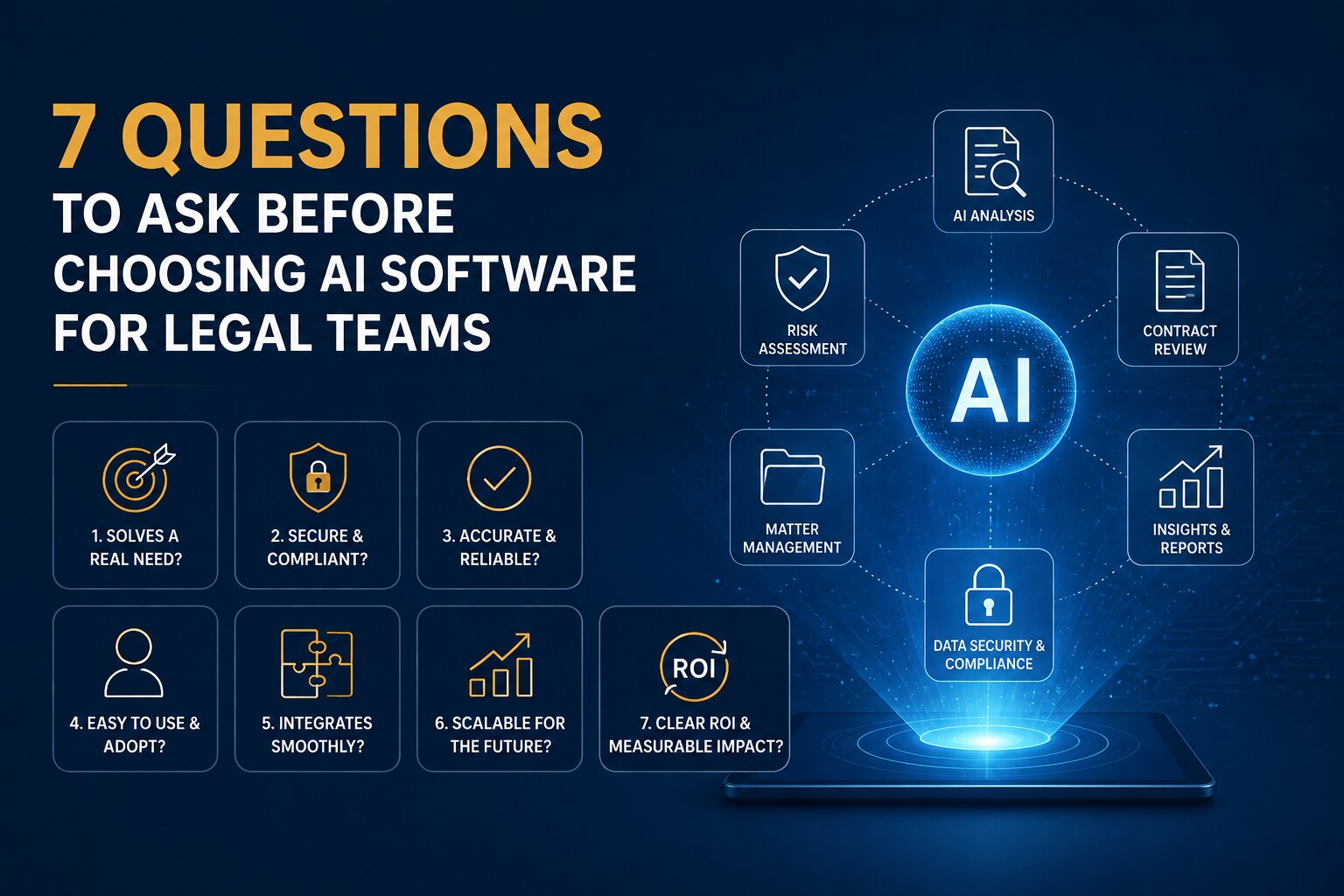
Choosing the right AI compliance solution involves more than selecting software with advanced technology. Legal teams should look for a platform that strengthens existing compliance processes, integrates with business systems, and provides practical insights that support better decision-making.
Key capabilities to consider include:
- Real-time compliance monitoring to identify potential issues as they occur.
- Automated alerts and notifications for policy breaches, missed approvals, and regulatory deadlines.
- Workflow automation to reduce manual administrative tasks.
- Centralised document management for contracts, policies, and compliance records.
- Comprehensive audit trails that simplify internal and external audits.
- Reporting dashboards that provide visibility into compliance performance and emerging risks.
- Risk scoring and analytics to help legal teams prioritise high-impact issues.
- Integration with existing legal and business systems to avoid information silos.
- Strong security and access controls to protect confidential legal information.
The most effective solutions are designed to support legal professionals rather than replace them. AI should enhance legal expertise by providing faster access to relevant information and highlighting risks that require attention.
Preparing Your Legal Team for AI-Driven Compliance
Successfully adopting AI-powered compliance monitoring requires more than implementing new technology. Organisations should also review their existing processes, governance frameworks, and ways of working.
A practical approach includes the following steps:
1. Assess Current Compliance Processes
Identify where compliance activities rely heavily on manual effort or where recurring issues frequently occur. These areas often present the greatest opportunities for improvement.
2. Prioritise High-Risk Workflows
Focus initial AI adoption on activities that have the greatest business impact, such as contract approvals, regulatory reporting, third-party risk management, or policy compliance.
3. Improve Data Quality
AI performs best when it has access to accurate, consistent, and well-organised information. Reviewing existing legal records and document management practices before implementation helps improve outcomes.
4. Train Legal and Compliance Teams
Introducing AI should be accompanied by practical training. Legal professionals need to understand how AI generates recommendations, interprets data, and supports compliance decisions.
5. Monitor and Refine Performance
Compliance monitoring is an ongoing process. Organisations should regularly review AI-generated insights, refine business rules, and update workflows to reflect changing regulations and organisational priorities.
Organisations that combine strong governance with intelligent automation are better positioned to build resilient and future-ready compliance programmes.
Legal operations platforms, such as those offered by Beveron Technologies, help organisations centralise legal information, automate compliance workflows, improve visibility across legal operations, and support stronger governance. When paired with well-defined compliance processes, these capabilities enable legal teams to focus more on strategic decision-making and less on repetitive administrative tasks.
Conclusion
As regulatory requirements become more complex and business operations continue to expand, legal departments need a more proactive approach to compliance management. Relying solely on manual reviews and periodic audits is no longer enough to keep pace with changing obligations and increasing organisational risk.
AI-powered compliance monitoring enables legal teams to identify potential issues earlier, automate routine monitoring, and gain real-time visibility into compliance activities. Rather than replacing legal professionals, AI strengthens their ability to make informed decisions, prioritise high-risk matters, and improve organisational governance.
For enterprise legal departments, the strategic value extends beyond efficiency. AI supports stronger risk management, better collaboration across business functions, improved audit readiness, and more consistent compliance practices. Organisations that embrace AI as part of a broader legal operations strategy will be better equipped to respond to evolving regulations while building a more resilient and agile legal function.
As businesses continue their digital transformation journey, investing in intelligent compliance capabilities is becoming a strategic advantage rather than simply a technology upgrade.
Frequently Asked Questions
1. What is AI-powered compliance monitoring?
AI-powered compliance monitoring uses artificial intelligence to continuously review legal documents, policies, workflows, and business data to identify potential compliance risks before they develop into regulatory or legal issues.
2. How does AI detect compliance risks?
AI analyses large volumes of structured and unstructured data, identifies unusual patterns, compares activities against organisational policies and regulatory requirements, and generates alerts when potential risks are detected.
3. Can AI replace compliance professionals?
No. AI supports compliance professionals by automating repetitive monitoring tasks and highlighting potential risks. Legal experts remain responsible for interpreting regulations, making decisions, and managing complex compliance matters.
4. What types of compliance risks can AI identify?
Depending on the organisation and system configuration, AI can detect:
- Missing approvals
- Policy violations
- Unusual contract clauses
- Expiring licences and certifications
- Regulatory reporting issues
- Third-party compliance risks
- Documentation inconsistencies
- Workflow exceptions
5. Which industries benefit most from AI-powered compliance monitoring?
Industries with significant regulatory obligations—including financial services, healthcare, manufacturing, retail, technology, energy, telecommunications, and the public sector—can all benefit from AI-powered compliance monitoring.
6. Is AI-powered compliance monitoring suitable for small legal teams?
Yes. AI can help smaller legal teams automate routine compliance activities, prioritise high-risk matters, and improve productivity without significantly increasing resources.
7. How long does it take to implement AI compliance software?
Implementation timelines vary depending on organisational size, existing systems, data quality, and compliance requirements. Many organisations begin by automating high-priority workflows before expanding AI capabilities across the legal function.
8. What should organisations look for when choosing AI compliance software?
Organisations should look for solutions that provide real-time monitoring, workflow automation, secure document management, audit trails, reporting dashboards, system integration, robust security, and scalability to support future growth.
Take the Next Step Towards Smarter Compliance
Managing compliance manually is becoming increasingly challenging as regulations evolve and legal workloads grow. Modern legal departments need better visibility, faster insights, and more efficient ways to identify and manage compliance risks.
Beveron Technologies provides legal operations and compliance management solutions that help organisations centralise legal information, automate workflows, strengthen governance, and improve compliance oversight across the enterprise.
If your organisation is looking to modernise its legal operations, explore how AI-powered legal technology can help your legal team detect risks earlier, improve operational efficiency, and build a stronger foundation for long-term compliance success.
Best legal compliance management software in the UAE
Best AI for legal teams in the UAE
Best corporate compliance automation in the UAE
If you need a free demo of the best legal compliance management software in the UAE, please fill out the form below.