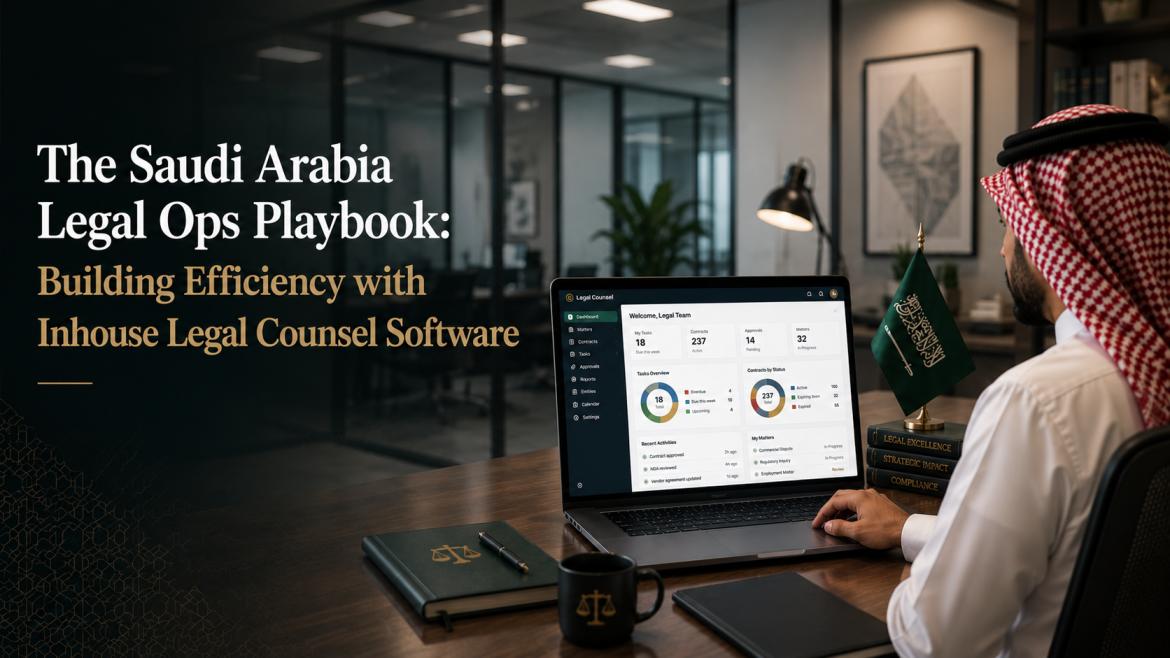
The Saudi Arabia Legal Ops Playbook: Building Efficiency with Inhouse Legal Counsel Software
When Manual Legal Operations Become a Business Risk
Across the Kingdom of Saudi Arabia, enterprise organizations are navigating one of the most complex regulatory and operational environments in the region's history. Vision 2030 has accelerated corporate growth, foreign investment, and regulatory evolution simultaneously—placing extraordinary pressure on in-house legal teams to perform faster, smarter, and with far greater accountability than ever before.
For many organizations, the gap between where their legal operations stand today and where they need to be is significant. Legal teams are still managing contracts in shared drives, tracking approvals through email chains, and producing compliance reports manually—a setup that made sense a decade ago but creates serious exposure in today's business climate.
This is exactly the environment where Smart Legal Counsel, a purpose-built in-house legal counsel software platform, is helping enterprise teams modernize how they work. This case study explores how one Saudi-based enterprise restructured its entire legal operations function using Smart Legal Counsel — and the operational outcomes that followed.
A Multi-Sector Enterprise Operating at Scale
The organization at the center of this case study is a diversified enterprise headquartered in Riyadh, with business units spanning real estate development, facilities management, and professional services. With operations across several Saudi cities and an expanding workforce of over 3,000 employees, the company's legal and compliance function had grown considerably in scope—though not in capability.
The in-house legal team of twelve professionals was responsible for contract lifecycle management, regulatory compliance, corporate governance, vendor agreements, and internal dispute resolution. The department supported five business units, each with distinct workflows, approval hierarchies, and reporting requirements.
Despite the team's expertise, their tools had not kept pace with the organization's growth. They were operating on a fragmented system of spreadsheets, email threads, and locally stored document folders — a setup that created predictable but persistent problems across every aspect of their work.
The Operational Challenges Holding the Legal Team Back
Bottlenecked Approvals and Contract Delays
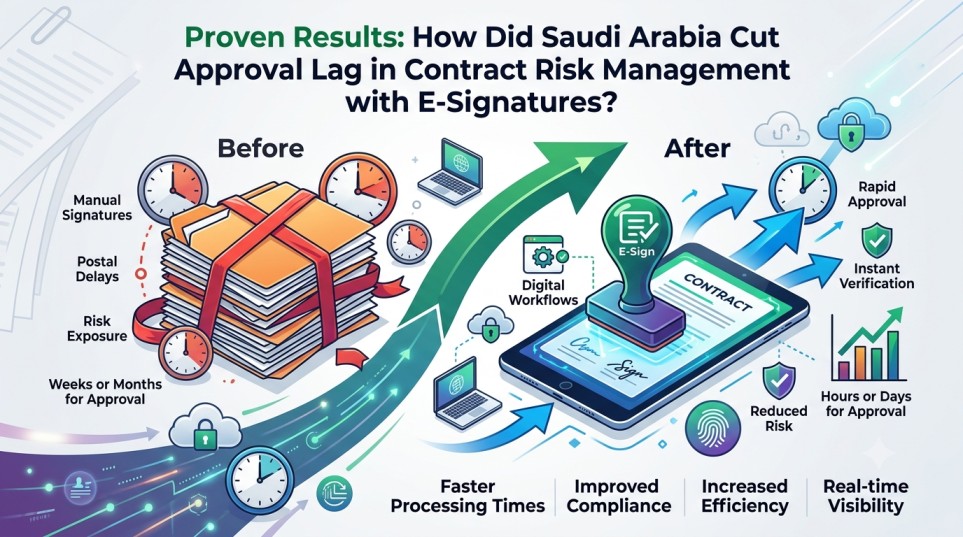
Contract approvals routinely took two to three weeks, with requests moving through email threads that often went unanswered for days. There was no visibility into where a document stood in the review process or who was responsible for the next action. Business units frequently escalated to senior leadership just to get standard agreements signed—a drain on executive time and team morale.
Fragmented Document Management
Legal documents were stored across multiple locations: shared network drives, personal desktops, and email attachments. Finding a specific contract version, understanding its current status, or confirming whether it had been executed was unnecessarily time-consuming. Version control was inconsistent, and the risk of working from outdated documents was real and recurring.
Compliance Tracking Without Visibility
Regulatory obligations in Saudi Arabia — including requirements tied to the Ministry of Commerce, ZATCA, and sector-specific regulators — required consistent monitoring. The legal team had no centralized system to track compliance deadlines, flag upcoming obligations, or produce audit-ready reports. Tracking was done through individual spreadsheets maintained by different team members, leading to inconsistent data and significant manual effort.
Siloed Communication Across Business Units
Without a shared platform, legal requests from different departments arrived through inconsistent channels. Some came via email, others through messaging apps, and some as verbal requests escalated through managers. There was no standard intake process, no way to prioritize workloads systematically, and no record of pending or completed requests across the team.
Reporting That Lagged Behind Reality
Senior leadership regularly requested updates on contract status, compliance posture, and legal workload — and the team spent considerable time compiling this information manually before each reporting cycle. By the time a report was ready, portions of it were already outdated.
How Smart Legal Counsel Transformed the Legal Operations Function
After evaluating several platforms, the organization selected Smart Legal Counsel as its in-house legal counsel software based on its enterprise-grade functionality, configurability, and fit with the team's specific workflow needs. Implementation was carried out in structured phases, allowing the legal team to transition without disrupting ongoing work.
Centralized Contract Lifecycle Management
Smart Legal Counsel became the single repository for all contracts and legal documents. Templates were standardized for common agreement types — NDAs, vendor contracts, service agreements, and employment documents — reducing drafting time and ensuring consistency. The platform's version control capabilities eliminated the confusion that had come from working across multiple file locations.
Structured Approval Workflows
Approval routing was configured to reflect each business unit's hierarchy. When a contract required sign-off, the system automatically identified the relevant approvers, issued notifications, and tracked progress in real time. Escalation triggers were set to automatically flag requests that exceeded defined timeframes, ensuring that bottlenecks surfaced quickly rather than quietly accumulating.
Compliance Monitoring and Obligation Tracking
A compliance module within Smart Legal Counsel was configured to map the organization's regulatory obligations across its active jurisdictions. Deadlines, filings, and periodic review requirements were centralized within the platform, with automated alerts sent to responsible team members ahead of key dates. This gave the legal team a live view of their compliance posture rather than a retrospective one.
Unified Legal Request Management
A structured intake portal replaced the informal, multi-channel request process. Business units submitted requests through a standardized form, which captured all the information the legal team needed to assess priority and begin work. Every request generated a trackable record, allowing team leaders to manage workloads systematically and provide accurate status updates to internal stakeholders.
Executive Dashboards and Automated Reporting
Smart Legal Counsel's reporting tools were configured to produce regular summaries of contract status, compliance metrics, team workload, and outstanding obligations. Senior leadership gained direct access to dashboards displaying real-time operational data—ending the cycle of manual report compilation before every executive review.
Results: What Changed After Implementation
The impact of adopting Smart Legal Counsel as the organization's core in-house legal counsel software became measurable within the first quarter of deployment.
- Contract approval turnaround time decreased by approximately 65%, with most standard agreements moving from submission to execution in four to six days rather than two to three weeks.
- The legal team reduced time spent on manual document retrieval and status tracking by an estimated 40%, freeing capacity for higher-priority advisory and compliance work.
- Compliance deadline misses dropped significantly following the implementation of automated obligation tracking and proactive alerts, moving the team from a reactive to a preventive compliance model.
- Legal request intake became fully standardized, reducing incomplete or misdirected requests by over 50% and cutting the average time-to-assignment for new matters by more than half.
- Executive reporting that previously required two to three days of manual preparation was replaced by on-demand dashboard access, giving leadership accurate, real-time visibility into the legal function at any time.
- Cross-department collaboration improved materially, with business units reporting greater confidence in the legal team's responsiveness and a clearer understanding of where their requests stood in the process.
Key Takeaways from This Transformation
The experience of this Riyadh-based enterprise offers practical lessons for any organization operating complex legal and compliance functions in Saudi Arabia—or across the broader Gulf region.
Fragmented tools create compounding inefficiencies. When legal teams manage contracts, compliance, and communications across disconnected systems, the overhead of coordination consumes time that should go toward substantive legal work. Consolidation onto a capable platform like Smart Legal Counsel addresses this at the root.
Automation does not replace legal judgment — it protects it. By removing manual tracking, reminder-setting, and report-building from the team's workload, automation gives legal professionals the space to focus on analysis, risk assessment, and strategic counsel. That is where their expertise creates the most organizational value.
Visibility drives accountability. When leadership can see the state of the legal function in real time—pending contracts, compliance status, and team capacity—decisions are better informed and expectations are more realistic on all sides.
And standardization enables scale. The organization can now onboard new business units or expand into new regulatory environments without rebuilding its legal operations from scratch. The workflows, templates, and compliance frameworks established within Smart Legal Counsel form a durable operational foundation.
Building a Legal Operations Function Fit for the Future
Saudi Arabia's business environment is becoming more sophisticated every year. Regulatory complexity is increasing, transactions are growing in scale and cross-border reach, and the expectations placed on in-house legal teams are expanding accordingly. Organizations that continue managing these demands with manual processes are taking on avoidable risk.
The experience documented in this case study demonstrates what becomes possible when an enterprise commits to modernizing its legal operations. With Smart Legal Counsel as its in-house legal counsel software, this organization moved from reactive and fragmented to proactive and connected—with measurable gains in speed, compliance integrity, and operational transparency.
For enterprise legal teams across Saudi Arabia and the wider Gulf region, the question is no longer whether to modernize legal operations. It is how quickly modernization can be achieved—and how effectively the right platform can be deployed to make it last.
Ready to Transform Your Legal Operations?
If your organization is managing contracts, compliance, or legal workflows across multiple teams or business units, Smart Legal Counsel is built for exactly that challenge. Whether you are looking to reduce approval delays, gain real-time compliance visibility, or simply bring structure to a fragmented legal function, the platform is designed to deliver measurable operational impact from day one.
Interested in learning more? Visit www.beveron.com or email info@beveron.com to explore how Smart Legal Counsel can support your organization's legal and compliance objectives.
Best in-house legal counsel software in Saudi Arabia
Best corporate legal department software in Saudi Arabia
Best legal counsel management software in Saudi Arabia
If you need a free demo on the best in-house legal counsel software in Saudi Arabia, please fill out the form below.