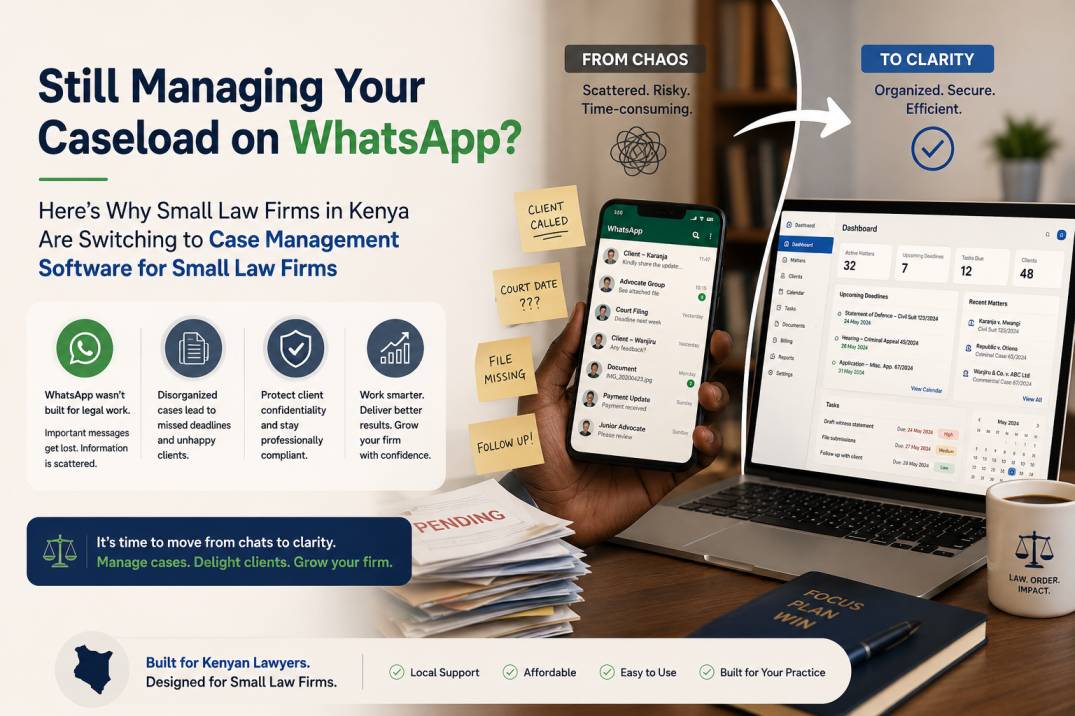
Still Managing Your Caseload on WhatsApp? Here's Why Small Law Firms in Kenya Are Switching to Case Management Software for Small Law Firms
The Breaking Point Every Growing Law Firm Recognises
Picture this: a client calls asking for an update on their property dispute. You spend the next ten minutes scrolling through WhatsApp threads, email chains, and scribbled notes trying to piece together where things stand. You find the last message — sent three weeks ago — and realise two follow-up tasks quietly slipped through the cracks.
If that scenario feels uncomfortably familiar, you are not alone.
Across Kenya, small and mid-sized law firms are grappling with the same fundamental problem: the tools that helped them start are no longer equipped to help them grow. Informal messaging apps, physical file systems, and disconnected spreadsheets may have worked when the caseload was light. But as client demands rise and the regulatory environment grows more complex, those workarounds are quietly costing firms time, money, and reputation.
This is the story of how one Kenya-based firm recognised that problem — and what happened when they made the switch to Smart Lawyer Office, a dedicated case management software for small law firms.
A Decade of Growth, Undermined by Operational Gaps
The firm had built a solid reputation over nearly a decade of practice, serving a mix of individual clients and small corporate accounts. At any given time, they were managing between 60 and 90 active matters across multiple practice areas. By any measure, they were a functioning, growing practice.
But growth had exposed the seams in their operations. As the caseload expanded, the partners began noticing consistent delays in document turnaround, missed court dates added to diaries too late, and client communication that had become fragmented across multiple channels. They were running a modern law practice on outdated operational infrastructure — and the gap was widening.
Operational Challenges That Were Costing the Firm More Than They Realised
Unstructured Communication With No Audit Trail
Like many small firms in Kenya, this practice had gradually adopted WhatsApp as an informal case management tool. Advocates shared updates in group chats, clients received status messages directly from individual phones, and important documents were forwarded through personal numbers.
It worked — until it didn't.
There was no audit trail for client communications. When an associate left the firm, their WhatsApp history left with them. And because conversations were scattered across personal and professional accounts, nothing was centralised or searchable.
Fragmented Workflows Across Every Function
Beyond communication, the firm's day-to-day operations suffered from several compounding inefficiencies:
- Court date tracking relied on a shared Google Sheet that was inconsistently updated. Missed reminders were not uncommon.
- Document management was split between physical files, personal laptop folders, and a shared drive with no clear naming convention. Finding a specific version of a contract could take 20 to 30 minutes.
- Billing and time tracking were done manually at month-end, often resulting in unbilled hours and disputes over invoices.
- Task delegation happened verbally or via WhatsApp, with no formal system for tracking whether work had been completed.
- Reporting to partners was largely anecdotal — there was no reliable way to see the status of all active matters at a glance.
Each of these gaps seemed manageable in isolation. Together, they were quietly undermining the firm's productivity and client service quality.
Implementing Smart Lawyer Office: A Structured Path to Operational Control
A Phased Transition Built for Minimal Disruption
After evaluating several options, the managing partner decided to implement Smart Lawyer Office — a cloud-based case management software for small law firms designed specifically for the operational realities of African legal practices.
The transition was structured in phases over six weeks, starting with matter intake and document management, then expanding to billing, task workflows, and client communication tracking.
Platform Capabilities That Addressed the Core Pain Points
Centralised Matter Management
Every case now lives in a single, structured profile within Smart Lawyer Office. Advocates can see the full timeline of a matter — from initial instruction to current status — without hunting through inboxes or physical files. The managing partner described it as "finally having a single source of truth."
Automated Court Date and Deadline Reminders
The platform's calendar and deadline management module sends automated reminders to the responsible advocate, their supervisor, and administrative staff at configurable intervals before critical dates. This alone addressed one of the firm's most persistent operational risks.
Document Version Control
All correspondence, contracts, court filings, and client documents are stored within the relevant matter file, with version history maintained automatically. The chaotic shared drive was retired within the first month of go-live.
Time Tracking and Billing Integration
Advocates now log time directly against matters as they work, rather than reconstructing hours at month-end. Smart Lawyer Office generates draft invoices from logged time entries, dramatically reducing the manual effort involved in billing cycles.
Task Assignment and Progress Monitoring
Partners can assign tasks to specific team members within a matter, set due dates, and track completion status — all from a single dashboard. Nothing falls through the cracks because nothing is communicated informally.
Structured Client Communication Records
Every call note, email summary, and client update is recorded within the matter file, creating a complete, searchable communication history that belongs to the firm — not to any individual's phone.
Measurable Business Outcomes Within the First 90 Days
Significant Gains in Day-to-Day Efficiency
- Administrative time spent on file retrieval dropped by approximately 65%. What previously took 20–30 minutes now takes under five, because documents are searchable and logically filed within each matter.
- Court date and deadline misses were eliminated entirely in the first two quarters post-implementation. The automated reminder system ensured no critical date went unnoticed.
- Task completion rates improved by roughly 40%, with partners reporting that visibility into outstanding work across the team had fundamentally changed how they managed their associates.
Stronger Financial Performance Through Accurate Billing
- Billable hour capture improved by an estimated 25–30%. With time logging integrated into daily workflows, hours that previously went unrecorded — brief client calls, quick document reviews — were now captured and billed.
- Invoice turnaround time decreased from an average of 19 days to under 7 days, driven by the automated billing module's ability to generate drafts from logged time rather than requiring manual reconstruction.
Improved Client Retention Through Consistent Service Delivery
Client satisfaction scores, measured through post-matter feedback forms, improved noticeably in the six months following implementation. Clients cited faster response times and more proactive communication as the primary improvements. Because every advocate could access the full matter history instantly, no client ever had to repeat context they had already provided.
A More Accountable and Cohesive Team
The shift from informal messaging to structured workflows within Smart Lawyer Office had a meaningful cultural effect across the team. Junior advocates reported feeling more confident about their responsibilities, and partners had clearer visibility into team capacity — making workload distribution more deliberate and more effective.
Strategic Lessons for Law Firms Ready to Scale
This firm's experience reflects a pattern playing out across small law firms throughout Kenya and the broader East African region: talented, experienced practitioners held back by operational systems that were never designed for scale.
The most important insight from this transition is that the problem was never the people — it was the processes. Once those processes were modernised through Smart Lawyer Office, the firm's existing capabilities were able to perform at a level that informal tools had been suppressing.
Three strategic lessons stand out for any firm considering a similar move:
Transformation does not have to be disruptive. The phased implementation allowed advocates to adapt steadily without being overwhelmed. Within weeks, the new system felt entirely natural.
The right case management software for small law firms delivers returns quickly. Improved billable hour capture and faster invoice cycles meant the platform's cost was offset within the first two billing cycles.
Risk and compliance management strengthen as a direct result. With proper audit trails, version control, and deadline monitoring in place, the firm's exposure to procedural risk decreased significantly — a benefit that compounds over time.
Operational Excellence Is Now a Competitive Advantage
Running a law firm in Kenya today demands more than legal expertise. It demands operational discipline. And operational discipline requires infrastructure that matches the ambition of the practice.
For small firms still relying on WhatsApp groups, shared drives, and manual billing spreadsheets, the question is not whether those tools will eventually become a liability — it is when. The firms that are scaling sustainably are those that chose to modernise before a missed deadline or a lost document made the decision for them.
Smart Lawyer Office was built for exactly this stage of growth. It is not a tool designed for large firms with enterprise budgets. It is purpose-built case management software for small law firms — practical, affordable, and designed around the realities of legal practice across Kenya and the wider region.
For this firm, the switch was not just an operational upgrade. It was the foundation for a more organised, more profitable, and more professionally resilient practice.
Interested in seeing how Smart Lawyer Office can work for your firm? Request a demo and speak with a specialist who understands the Kenyan legal market.
Best case management software for law firms in Kenya
Best law practice management software in Kenya
Best litigation management software in Kenya
If you need a free demo on the best case management software for law firms in Kenya, please fill out the form below.