Webinar Recap
Law firms generate significant amounts of data through matters, cases, client interactions, documents, time entries, billing, hearings, workflows, and financial activities. Yet, much of this information remains fragmented across different systems, making it difficult for firms to gain a complete view of their operations.
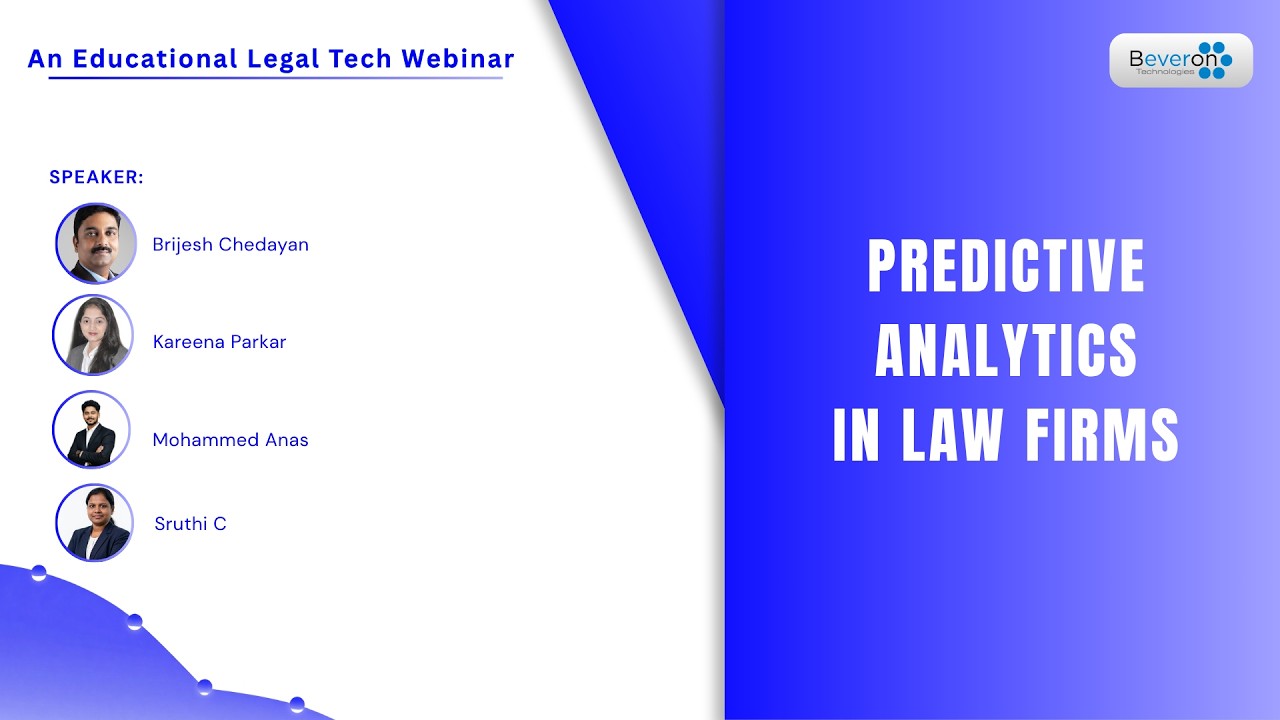
The webinar, “Predictive Analytics in Law Firms: From Data to Decisions,” explored how law firms can move beyond traditional reporting and use connected data, AI, and machine learning to identify patterns, anticipate risks, forecast trends, and support better decision-making.
The session focused on the journey from raw operational data to actionable intelligence. It examined the role of predictive analytics in forecasting matter volumes, identifying workload pressures, detecting operational and financial risks, understanding client behaviour, and improving overall law firm performance. The webinar also addressed the importance of data quality, governance, privacy, human oversight, and responsible AI.
Speakers
- Brijesh Chedayan – CEO
- Kareena Parkar
- Mohammed Anas
- Sruthi C
The webinar brought together perspectives on how predictive analytics can help law firms transition from fragmented, reactive operations towards more connected, proactive, and data-driven decision-making.
Predictive Analytics in Law Firms: From Data to Decisions
The New Reality of Legal Decision-Making
Law firms have more data than ever, but data alone does not create intelligence.
Every matter generates valuable information through case updates, client communications, documents, time records, billing, hearings, tasks, and outcomes. However, much of this information remains spread across different systems, spreadsheets, and disconnected processes.
As a result, answering important questions—such as which matters may be at risk of delay—can require manual reporting and time-consuming analysis. Traditional reports explain what has already happened. Predictive analytics adds another dimension by helping firms understand what may happen next, allowing leaders to identify emerging risks, workload pressures, and operational trends earlier.
What Is Predictive Analytics?
Predictive analytics uses data and technology to identify patterns and anticipate likely outcomes.
It combines historical legal and business data with AI, machine learning, pattern recognition, and forecasting techniques.
For law firms, this may involve estimating the likely duration of similar matters, forecasting future workload, identifying potential financial risks, or recognizing changes in client engagement.
Historical Data + AI and Machine Learning + Pattern Recognition + Forecasting = Actionable Predictions
Predictive analytics does not replace legal expertise or professional judgement. Instead, it provides earlier intelligence that can support better planning and more informed decision-making.
From Reactive to Proactive Legal Operations
Predictive intelligence helps firms act before problems become larger issues.
Traditionally, firms often respond after a problem has already emerged. A deadline is missed, a team becomes overloaded, or a billing issue is discovered after it has affected financial performance.
Predictive analytics helps identify potential risks and trends earlier. For example, if data indicates that a practice team is moving towards excessive workload, leadership can redistribute matters before capacity and client service are affected. Similarly, unusual billing activity can be identified before it develops into significant revenue leakage.
The objective is not simply to produce more reports, but to create earlier visibility that supports confident action.
The Data Behind Predictive Legal Intelligence
Connected data provides the foundation for meaningful predictive insights.
Important data sources within a law firm include:
- Matter and case data
- Client and engagement information
- Billing, financial, and time data
- Documents, communications, and workflows
- Hearings, productivity, and outcome data
Individually, these records may appear to be routine operational information. When connected, they can reveal patterns across matters, performance, workloads, and financial activity.
The opportunity for many firms is not necessarily collecting more information but connecting and organizing the data they already generate.
How AI and Machine Learning Add Intelligence
AI helps firms analyse information and identify patterns that may otherwise be difficult to detect.
The webinar explored capabilities including pattern recognition, classification, trend detection, risk scoring, anomaly detection, forecasting, and natural language processing.
These technologies can help identify emerging demand, performance changes, workflow bottlenecks, and potential risks. AI-powered analysis may also help review large volumes of matter information and communications more efficiently.
The purpose is to augment legal professionals with better visibility and analysis. Human judgement remains essential when interpreting predictions and making legal or strategic decisions.
Key Use Cases for Predictive Analytics in Law Firms
Predictive analytics can support decision-making across operations, finance, resources, and client relationships.
Predicting Matter and Case Trends
Firms can forecast incoming matter volumes, identify changes in practice-area demand, and anticipate case duration and workload requirements. This supports capacity planning and helps identify emerging opportunities.
Forecasting Workload and Resource Requirements
Predictive analytics can identify teams approaching capacity challenges, detect workload trends, uncover bottlenecks, and support better resource distribution before demand peaks.
Identifying Operational and Financial Risks
Potential applications include identifying matters at risk of delay, detecting unusual billing patterns, uncovering unbilled work, and recognising workflow or payment risks earlier.
Client and Business Intelligence
Firms can analyse engagement patterns, revenue trends, service demand, retention signals, and potential business development opportunities. Changes in client engagement may provide an early signal that a relationship requires attention.
From Data to Decisions: A Five-Step Framework
Predictive analytics works best as a structured process from information collection to informed action.
Collect – Gather legal, operational, financial, and client data.
Connect – Unify fragmented information across systems.
Analyse – Apply AI and machine learning to identify meaningful patterns.
Predict – Identify trends, risks, and likely outcomes.
Act – Use insights to support faster and smarter decisions.
Each stage is important. Predictive insights are only as reliable as the underlying data and the systems used to connect and analyse it.
Challenges and Responsible AI in Legal Analytics
Technology must be supported by reliable data, governance, and human oversight.
Data fragmentation, legacy systems, inconsistent data quality, integration complexity, and limited analytics expertise can affect the usefulness of predictive insights.
Law firms must also address governance, confidentiality, privacy, transparency, bias, and regulatory compliance. Legal professionals must remain accountable for decisions, while AI-generated recommendations should be understandable, traceable, and supported by appropriate data protection.
Beveron Smart Lawyer Office
A connected legal technology foundation can help turn operational data into actionable intelligence.
Beveron Smart Lawyer Office brings together client and matter management, documents, workflows, hearings, tasks, billing, reporting, and analytics within a more centralised environment.
With centralised data, workflow automation, analytics and reporting, AI-powered intelligence, and real-time visibility, law firms can move from fragmented information towards a connected data-to-decision ecosystem.
Conclusion
The future of legal decision-making depends on turning data into meaningful action.
The advantage will not come simply from having more information. It will come from connecting legal and operational data and transforming it into intelligence that supports better decisions.
Law firms can begin by treating data as a strategic asset, building connected systems, using AI to augment expertise, and adopting a more proactive approach to risks and opportunities.
From data to intelligence. From intelligence to decisions. From decisions to better outcomes.