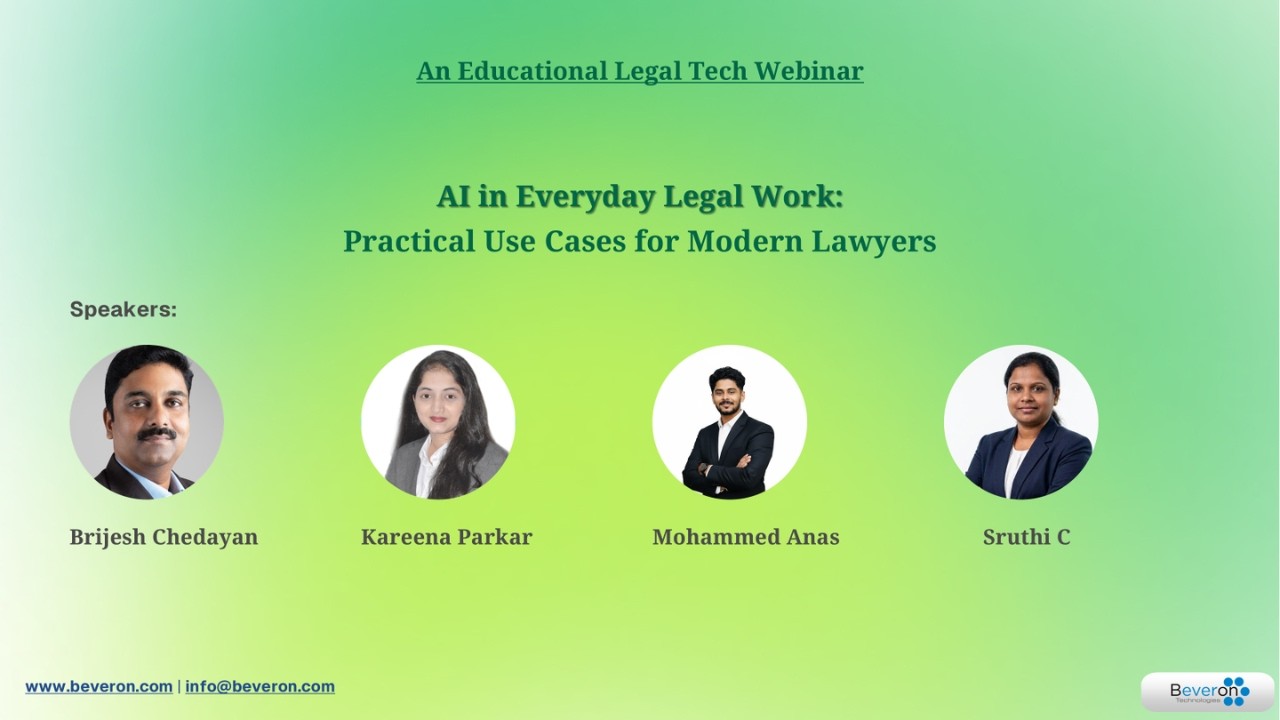
AI is no longer a future technology for legal practice. Beveron Technologies recently hosted a 20-25 minute educational webinar on where AI can support lawyers in their daily work, and what firms need in place to use it responsibly. The session was presented by Kareena Parkar, Sruthi C and Mohammed Anas, with Beveron's CEO, Brijesh Chedayan, in attendance. Mr. Chedayan is a Dubai-based LegalTech entrepreneur with over 25 years of experience in emerging technologies and legal technology consulting.
The session's guiding question was not "Can AI do this task?" but "Where can AI support lawyers while keeping professional judgment and accountability with the lawyer?"
The Lawyer's Daily Friction
Lawyers spend a lot of time on repetitive work around document review, legal research, compliance monitoring, contract analysis and case management. Take a litigation team that receives hundreds of documents on a new matter. Finding the relevant clauses, dates, facts and evidence by hand takes considerable time. AI can reduce this friction, not by replacing legal expertise, but by cutting the repetitive work that surrounds it.
Four Practical Use Cases
1. Litigation document review: faster issue-finding
AI can gather and categorize case documents, flag relevant passages and draft summaries. This helps lawyers prioritize which documents deserve closer attention, while they verify the content and lead strategy. Litigators in Qatar using Beveron's AI-powered legal case management solution reported a 30% reduction in case processing time and 40% faster document searches.
2. Drafting that starts "on target."
Generative AI can produce first drafts of responses to complaints, pleadings and counterarguments to motions, which removes the blank-page problem. The webinar framed this as a 10/80/10 model:
- 10% thinking: the lawyer defines the strategy, facts, objectives and key arguments.
- 80% drafting: AI generates the first draft.
- 10% tidying: the lawyer reviews, refines and approves the document before filing.
3. Legal research that surfaces the right law
AI can summarize authorities and surface relevant precedent in minutes rather than hours, so lawyers can spend their time on argument and client advice. Speed does not replace verification, though. Lawyers still need to read the original authority and confirm that it applies to their matter.
4. Compliance, contracts and ongoing risk control
Here AI supports continuous risk management, not just one-off tasks:
- Regulatory compliance: monitoring regulatory changes and flagging obligations before they become exposure.
- Smart contract analysis: highlighting risks, inconsistencies and key clauses during review and negotiation.
- Lifecycle management: tracking obligations, deadlines and renewals to reduce admin burden and avoid missed dates.
Predictive AI: From Reporting to Decisions
Traditional reporting shows what has already happened. Predictive AI helps teams spot patterns that point to what may happen next. The webinar highlighted three applications:
- Forecasting workload: predicting matter duration and resource needs before bottlenecks form.
- Detecting risk signals: identifying operational and financial risk patterns earlier in a matter's lifecycle.
- Flagging billing anomalies: surfacing unusual billing patterns before they become client disputes.
AI identifies the signals, and legal professionals decide what they mean and what action to take.
A Real-World Warning: Hallucinations Can Become Sanctions
AI can generate content that sounds convincing but is wrong. In a widely reported case, a New York judge sanctioned lawyers after their brief included six fictitious case citations generated by ChatGPT. The cases did not exist.
The rule of thumb from the session: never file or rely on AI output without verification. In practice, that means confirming that each case exists, checking the citation, reading the original decision and making sure the authority supports the argument. Firms should apply citator processes (Shepardize/KeyCite-equivalent) and check all citations against trusted sources.
The Responsible AI Playbook
The webinar outlined three areas every firm should standardize:
- Protect confidentiality: use strong security controls and governance so sensitive client data is never improperly exposed to AI tools.
- Manage bias and fairness: review AI outputs regularly and apply human oversight to catch bias inherited from historical training data.
- Maintain accountability: AI can support decisions, but professional judgment and legal responsibility always stay with the lawyer.
Responsible AI is about the processes, controls and people around the technology, not only the technology itself.
Putting It into Practice: Beveron Smart Lawyer Office (SLO)
The session closed by showing how these principles come together in Beveron Smart Lawyer Office, an AI-enabled platform for modern law firms. It brings case management, workflow automation, compliance and controlled AI into one secure environment. SLO is built around four goals:
- Automate routine work, freeing lawyers for high-value strategy.
- Accelerate research and drafting through faster analysis, precedent-finding and first drafts.
- Enforce verification and oversight, building confidentiality, human review and accountability into every workflow.
- Operationalize AI safely, with governance, security and professional standards built in.
Key Takeaway
The future of legal practice belongs to firms that use AI responsibly: automating the routine, amplifying expertise and keeping human judgment at the center. The real opportunity comes from combining AI with legal expertise, verification, confidentiality and sound governance, not from simply using more AI.
Want to See More?
To request a live demonstration of Smart Lawyer Office or access additional resources, visit www.beveron.com or email info@beveron.com.