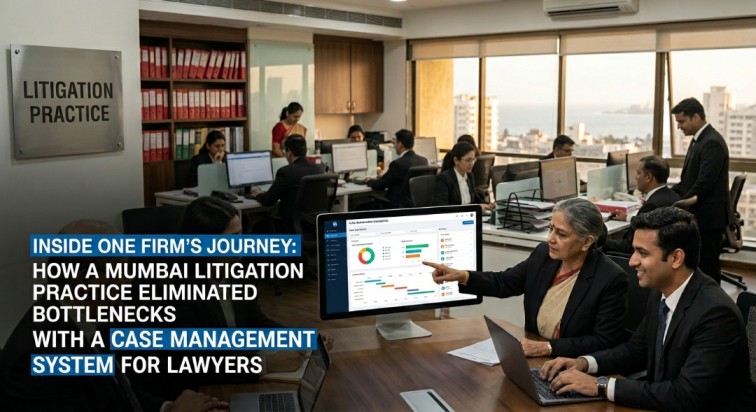
Inside One Firm's Journey: How a Mumbai Litigation Practice Eliminated Bottlenecks with a Case Management System for Lawyers
The Operational Reality Facing Indian Litigation Practices Today
Running a busy litigation practice in India has never been straightforward. Between managing hundreds of active matters across multiple courts, tracking hearing schedules, maintaining compliance with procedural deadlines, and keeping clients informed — the administrative burden on legal teams can be extraordinary. For many mid-to-large-sized law firms in cities like Mumbai, these operational pressures have only intensified over the past few years.
The Mumbai litigation practice featured in this case study understood that challenge well. With a growing caseload, an expanding team, and clients demanding faster turnaround and greater transparency, the firm's existing workflow — built largely on spreadsheets, email threads, and physical files — was starting to crack under the pressure.
This is the story of how they transformed their operations by implementing Smart Lawyer Office, a purpose-built case management system for lawyers, and what that decision ultimately meant for their productivity, compliance, and day-to-day efficiency.
Client Background
The firm is a mid-sized litigation practice based in Mumbai, Maharashtra, with a focus on civil, commercial, and corporate litigation. With a team of eighteen lawyers — including senior advocates, associates, and paralegals — the practice handles cases across the Bombay High Court, district courts, and various tribunals.
The firm's clients range from individual high-net-worth individuals to established corporate entities across sectors including real estate, financial services, and manufacturing. Many clients maintain long-term retainer relationships, meaning the firm manages not just isolated cases but entire litigation portfolios.
From a structural standpoint, the practice operates across three functional groups: litigation management, document drafting, and client relations. Each group had developed its own informal systems over the years, which created significant coordination challenges when cases required cross-functional collaboration — a common occurrence in complex commercial matters.
The Challenges: When Manual Systems Stop Scaling
Fragmented Workflows and Information Silos
Before implementing a structured case management system for lawyers, the firm relied on a patchwork of tools — WhatsApp groups for internal communication, shared Google Sheets for matter tracking, and physical folders for document storage. On any given day, critical case information was spread across multiple platforms with no single source of truth.
Senior lawyers often spent the first hour of their morning pulling together updates from different team members before they could assess the status of active matters. That is not a minor inconvenience; across an eighteen-person team, that inefficiency compounded into significant lost productivity every week.
Missed Deadlines and Compliance Risk
Hearing dates, filing deadlines, and limitation periods are not forgiving in litigation. The firm had experienced several near-misses with court deadlines due to inadequate reminder systems and poor visibility into upcoming critical dates. In one instance, a conflicting court date was only identified the evening before, requiring an urgent adjournment application that could have been avoided entirely.
In a practice environment regulated by professional conduct rules and court procedures, compliance lapses carry serious reputational and legal consequences. The firm recognized this exposure and understood that an informal tracking approach was no longer acceptable.
Approval Bottlenecks Slowing Client Communication
Drafting and reviewing client communications, sending legal opinions, and issuing fee invoices all required sign-off from senior partners. Without a structured approval workflow, documents frequently sat in email inboxes waiting for review — sometimes for days. Clients noticed the delays, and the firm's responsiveness scores were quietly suffering as a result.
Reporting Was Time-Consuming and Inconsistent
Partners who needed a reliable picture of the firm's litigation portfolio — pending matters, upcoming hearings, outstanding invoices, client-wise matter status — had no easy way to generate that view. Compiling a simple monthly status report could take a junior associate several hours, drawing time away from billable work.
The Solution: Implementing Smart Lawyer Office
After evaluating several platforms, the firm selected Smart Lawyer Office as their case management system for lawyers. The decision came down to the platform's specific alignment with litigation workflows in India — particularly its built-in support for court date tracking, matter hierarchy management, and document version control.
The implementation was carried out in phases over six weeks, beginning with a core configuration of the matter management module, followed by team onboarding and workflow customization.
Centralized Matter Management
Smart Lawyer Office provided the firm with a single, unified workspace for all active matters. Each case was assigned a structured profile containing client details, court information, associated documents, team assignments, billing data, and a chronological activity log. For the first time, any team member could access a complete and current picture of any matter in seconds.
Automated Hearing and Deadline Tracking
One of the most immediately impactful features was the platform's automated deadline and hearing reminder system. Lawyers could log court dates, filing deadlines, and statutory limitation periods directly into the system, with automated notifications sent to relevant team members at configurable intervals — typically seven days, three days, and one day before each critical date.
This simple but powerful mechanism addressed one of the firm's most pressing compliance risks almost overnight.
Structured Approval Workflows
Smart Lawyer Office allowed the firm to configure approval workflows for key document categories — client correspondence, legal opinions, retainer agreements, and invoices. Documents were routed automatically to the appropriate reviewer, with clear status tracking and escalation triggers if reviews exceeded defined time thresholds. The informal, inbox-based approval process was replaced with something predictable and auditable.
Reporting Dashboards and Portfolio Visibility
Partners gained access to a real-time dashboard displaying the firm's entire matter portfolio — segmented by practice area, client, hearing status, and billing stage. Monthly reporting that previously took hours was reduced to a matter of minutes, with data pulled directly from active matter records rather than compiled manually.
Results and Business Impact
Within three months of full deployment, the firm recorded measurable improvements across every major operational area. The results were not the product of a single breakthrough, but rather the cumulative effect of eliminating dozens of small daily inefficiencies that had previously gone unaddressed.
Metric | Improvement |
Deadline-Related Compliance Incidents | Reduced by 95% within 90 days |
Time Spent on Matter Status Reporting | Reduced by approximately 70% |
Document Approval Turnaround | Improved from 3–5 days to under 24 hours |
Client Response Time | Improved by an estimated 45% |
Onboarding Time for New Matters | Reduced by 60% |
Hours Saved Per Lawyer Per Week | Average of 6–8 hours on admin tasks |
Compliance and Risk Reduction
The automated hearing and deadline tracking system effectively eliminated the compliance near-misses that had caused anxiety within the firm. With structured reminders in place, lawyers consistently received advance notice of critical dates — giving them adequate preparation time and significantly reducing last-minute court applications.
Improved Team Collaboration
With all matter information centralized in Smart Lawyer Office, inter-team communication became notably more efficient. Litigation associates, drafting specialists, and client relations staff could coordinate through the platform rather than across fragmented communication channels. The volume of internal status-checking emails dropped substantially within the first month.
A More Responsive Client Experience
Faster approvals translated directly into faster client communication. Partners found themselves spending less time chasing document reviews and more time engaged in substantive legal work. Several long-standing clients noted the improvement in responsiveness during informal feedback conversations, and the firm's Net Promoter Score for client satisfaction increased noticeably over the following quarter.
Key Takeaways
The Mumbai firm's experience offers a clear and practical illustration of what a well-implemented case management system for lawyers can achieve in a real litigation environment. A few themes stand out:
• Operational complexity doesn't self-resolve. Manual systems that once worked at small scale create compounding inefficiencies as a practice grows. A structured platform intervention is often the only viable path forward.
• Compliance protection is a core operational benefit, not a secondary feature. Automated deadline tracking is not a convenience — in litigation, it is a professional necessity.
• Workflow standardization enables growth. By replacing informal, person-dependent processes with structured, repeatable workflows, the firm built an operational foundation capable of supporting further expansion without proportionally increasing administrative overhead.
• Data visibility supports better leadership decisions. When partners can see their portfolio clearly and in real time, they make better resourcing, billing, and client management decisions.
Smart Lawyer Office — Purpose-Built for Indian Litigation Teams Smart Lawyer Office is a case management system for lawyers designed specifically for the workflows, compliance requirements, and operational realities of legal practice in India. From automated hearing reminders and matter portfolio management to document approval workflows and client billing — Smart Lawyer Office provides the tools litigation teams need to operate with precision and confidence. |
Conclusion
For law firms across India navigating the twin pressures of growing caseloads and rising client expectations, the question is no longer whether to modernize — it is how quickly that modernization can be achieved.
The Mumbai litigation practice at the center of this case study did not undergo a dramatic reinvention. What they did was simpler, and arguably more important: they replaced the informal, fragmented systems that were quietly costing them time, compliance risk, and client goodwill with a structured, purpose-built case management system for lawyers that addressed their actual operational pain points.
The results — faster approvals, stronger compliance, better team coordination, and a more responsive client experience — are a direct reflection of what happens when the right legal technology is matched with the right implementation approach.
As legal practice in India continues to evolve toward greater digitization and client service demands continue to rise, the firms that build strong operational foundations today will be the ones best positioned to lead tomorrow. Smart Lawyer Office was built to support exactly that kind of forward-thinking, growth-oriented practice.
Best case management system for lawyers in India
Best litigation management software in India
Best legal practice management system in India
If you need a free demo on the best case management system for lawyers in India, please fill out the form below.