For group legal & company secretarial teams · UAE and GCC
Entity & Governance Management Software
Entity Management and Corporate Governance Software for Holding Groups and Group Companies
Smart Legal Counsel holds every company in the group on one record and runs the governance work those companies generate: boards, resolutions, policies, approvals, registers, licences and obligations. The register, the boardroom and the workflow, on one record.
- 10,000+ legal professionals
- 24 countries served
- 500+ enterprises
What is entity and governance management software?
Smart Legal Counsel's Entity and Governance Management module is entity management software for holding groups: one system of record for every company in the group, and the engine that runs the governance work those companies generate, covering boards, resolutions, policies, approvals, registers, licences and obligations.
One record per entity. Subsidiaries, directors, stakeholders and authorised signatories, powers of attorney, statutory registers, licences and registrations sit on the entity they belong to, not scattered across folders and inboxes.
Both halves, one system. Most vendors sell the register or the boardroom. Smart Legal Counsel holds both on the same record, so the resolution that appointed the director updates the directors register it sits beside.
Authority is explicit, not remembered. The directors register, the authorised signatories, the powers of attorney with their validity and the delegation matrix answer who can commit which entity, to what, until when.
The work routes itself. Board and committee approvals, resolution workflows, policy review cycles and the delegation of authority process run through the approval hierarchy, with notifications and escalations chasing whatever stalls.
Who it is for. The in-house legal, company secretarial and governance teams of holding companies, groups, conglomerates and family offices across the UAE and GCC.
Why do groups move the register out of spreadsheets?
Because a group's corporate record is a living set of interdependent facts spread across dozens of entities, and a spreadsheet holds none of them accountable. Here is where it breaks, and what the module does about each one.
One change, four places to update
A subsidiary appoints a director and the record, the chart, the register and the signatory list should all move. The module holds them on one entity record, so one update moves everything, and the chart redraws itself.
Nobody is sure who can sign
Signing authority lives in memory and in a PDF someone once saved. Stakeholders and authorised signatories, powers of attorney with validity and the delegation matrix answer it from the record, in a minute.
The meeting cycle eats the week
Notice, agenda, pack, meeting, resolutions, minutes, filing, per entity, per committee. Board management runs the whole loop on a configured seven-stage lifecycle against the entity the meeting belongs to.
Approvals stall in inboxes
A board approval or policy review sits with one person and nobody knows. Every approval carries a status, a route and a name, and notifications and escalations chase the holder for you.
Obligations lose their owner
An obligation with no name against it slips quietly. The compliance calendar assigns every obligation an owner per entity, monitors completion and keeps the auditable record behind it.
The auditor asks, and the clock starts
Ownership chain, authorising resolutions, current licences, on request. The governance dashboard, entity-filtered views and role-based retrieval produce the answer from the record, in an afternoon.
What does one entity record hold?
This is corporate records management software at entity level: ten registers held on the company they belong to, maintained once and read by every workflow, chart, approval and report on this page.
Subsidiaries
Every subsidiary and branch under the entity that holds it, with ownership shown on the connection.
Directors
The directors register per entity, with appointments across the whole group in one view.
Stakeholders & Signatories
Who holds a stake and who may sign, held on the entity they belong to, not in memory.
Contracts
Every contract held against the entity with its type recorded, powers of attorney among them.
Powers of Attorney
The authority granted and its validity period tracked, so an expiring authority is visible before it lapses.
Statutory Registers
Statutory registers with document categories, beside the corporate records they derive from.
Licences & Registrations
Held with document categories, and renewed with history and tracking per entity.
Approvals
Every approval on the entity with its status, its route and the name currently holding it.
Delegation Matrix
Entered through the approval hierarchy: who may commit the entity, to what, up to which threshold.
Policies
Policy management per group or entity, each policy on its own review and approval cycle.
Document Retention
Retention managed by client document type, applied across the governance repository.
How does the software keep the group structure chart accurate?
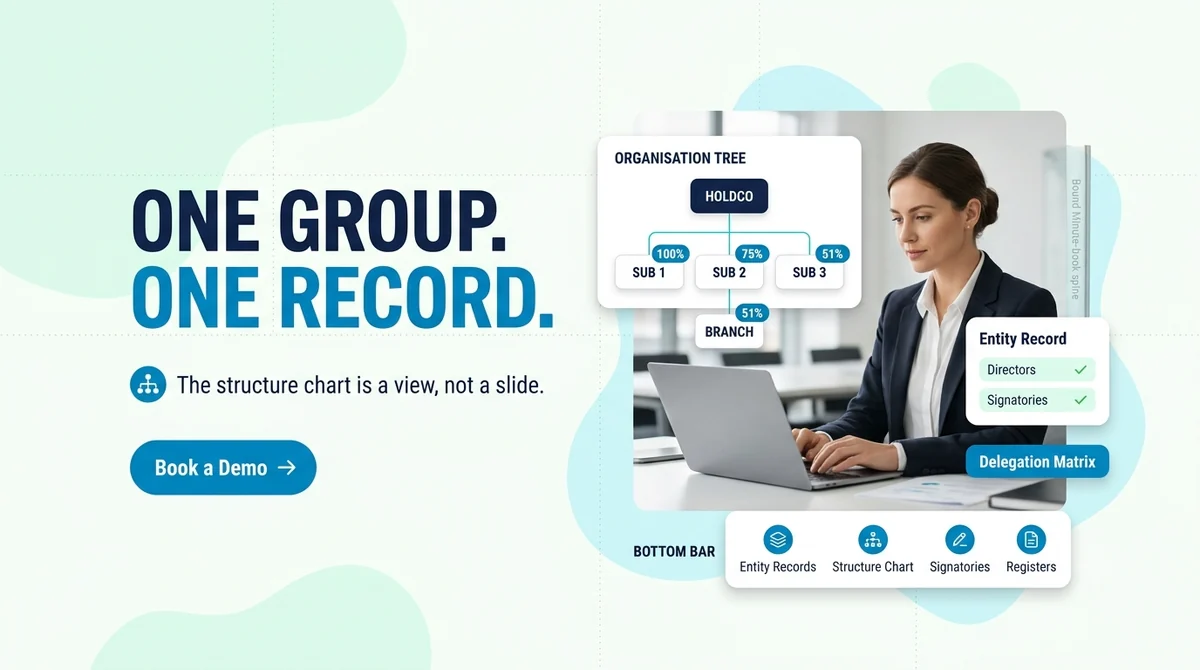
Because the organisation chart for subsidiary entities is generated from the entity records rather than drawn beside them. It is a view of the register, not a slide someone redraws before every board meeting, so the structure a director sees is the structure the record holds.
- Group entity management. Every company in the group on one register, each with its own record, officers and obligations.
- Subsidiaries and branch records. Branches and subsidiaries sit under the entity that holds them, with ownership shown on the connection.
- Legal entity information. The identifying data for each entity in one central store, shared by every other module that references it.
- Entity-level governance reporting. Report on one entity, one branch of the tree, or the whole group, without rebuilding the view each time.
How does the software run a board or committee meeting?
This is board and committee meeting management software running seven stages, each one landing on the entity the meeting belongs to, with resolution tracking and minutes management built into the rail rather than bolted on after it.
-
01
Calendar and notice
Schedule the board or committee meeting against the entity it belongs to. The meeting inherits that entity's record, and notice goes out to the attendee list with the lead time your organisation configures.
Scheduling Notice -
02
Agenda build
Build the agenda item by item, carrying forward matters left open at the last meeting. Each item can carry its own owner, supporting documents and expected decision.
Agenda Carried forward -
03
Board pack circulation
Assemble the board pack from the agenda and its attached documents, then circulate it to directors from inside the platform. Every document in the pack keeps its version history.
Board pack Circulation -
04
Meeting and committee matters
Record attendance, note the matters discussed against their agenda items, and capture actions as tasks assigned to named owners with due dates.
Attendance Task management -
05
Resolutions and approvals
Draft, circulate and approve resolutions through configured resolution workflows, with board and committee approval steps routed to the right approvers and every approval recorded.
Resolution workflows Approvals recorded -
06
Minutes draft and approval
Draft the minutes from the agenda, attendance and resolutions, route them for review and approval, and keep every revision in the document history. Minutes are always approved by a person.
Minute storage Version history -
07
Register and repository
File the approved minutes and resolutions against the entity record in the governance repository, where role-based access, retention rules and search apply, and where the auditor can be answered from.
Repository Retrieval
Configured to your calendar, filtered to your entity. Stages, mandatory fields, notice lead times, approval routing, reminder offsets and document templates are set per organisation and per committee, and the governance and meetings views filter by entity, so each company secretary works one company or the whole group from the same screen. See the lifecycle run on one of your own committees.
How does governance workflow automation keep approvals moving?
Six governance workflows run themselves through the approval hierarchy your group configures, and the integrated e-signature platform closes them with a recorded signature. Every routed item carries a status, a route and a name, so a board approval workflow never depends on somebody remembering to forward an email.
- Legal review
- General Counsel
- Board approval ESCALATED
- Board and committee approvals.
Sends the item to the approvers on the hierarchy, records each decision, moves it on.
- Resolution workflows.
Circulates a resolution for approval and closes it when the last approver has decided.
- Policy review and approval cycles.
Re-opens a policy on its own review cycle and routes it through its approval chain.
- Delegation of authority process.
Reads the delegation matrix and sends the request to whoever holds the authority at that threshold.
- Task management.
Turns a meeting action into an owned task with a due date and a status.
- Notifications and escalations.
Chases the person holding the item, then escalates when it sits too long.
- Integrated e-signature.
Drag and drop signature placeholders onto the document, initiate the approval and signature round, and file the signed version with every approval recorded.
Smart Legal Counsel's AI, applied to the governance record
The platform's AI legal process automation works on the record this module keeps. It drafts, it surfaces, it answers. A person approves; nothing is filed, signed or decided without one.
Drafting support
Drafting support for governance documents and correspondence, with every draft reviewed and approved by a person before it goes anywhere.
Surfacing what is due
It surfaces what is due and what is waiting: the obligations, the renewals and the approvals sitting with someone, so your team decides what to do about them.
Answering from the record
Ask a question of the governance record the group already holds and get the answer from it, with a person judging what the answer is worth.
On your permissions, on your servers if you choose. The AI runs on each user's own access rights, in the cloud or on-premise on the group's own servers, and a person reviews and approves everything it produces. See secure on-premise AI for legal teams for how Beveron keeps AI inside your infrastructure.
What does the software watch for every entity?
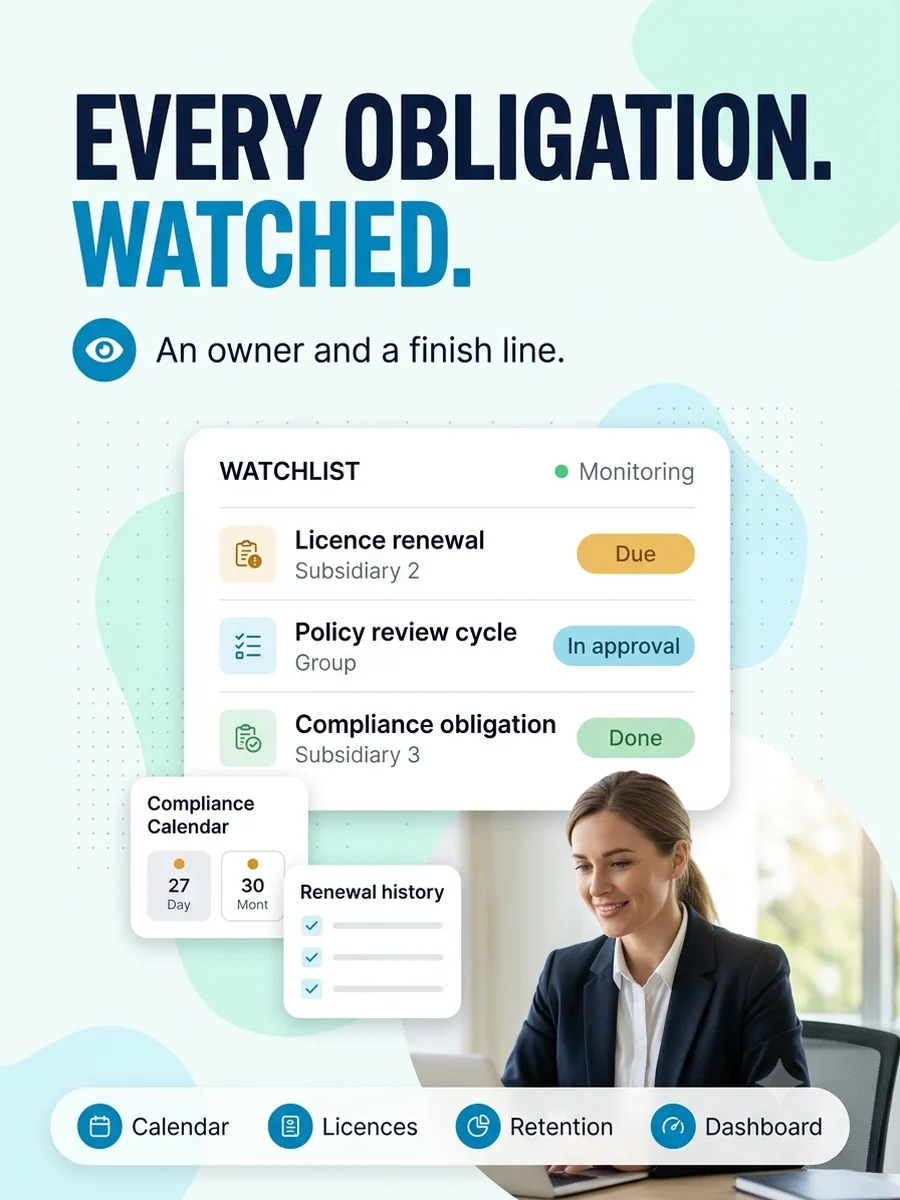
A compliance calendar software layer for legal teams, running under every entity in the group. The obligations, the day counts and the templates are the ones your team configures; the software watches what you set and chases who you name.
- The compliance calendar.
Statutory and regulatory obligations per entity, each with a responsible owner and completion monitoring behind it.
- Licences and registrations.
Held with document categories and tracked through renewal, so licence and permit renewal tracking runs per entity and rolls up per group.
- Document retention.
Retention by client document type across the governance repository, applied by rule rather than by habit.
- Renewal history and tracking.
Every renewal keeps its history, so what was renewed, when and by whom is a record, not a recollection.
- The governance dashboard.
Rolls the watchlist up: pending approvals, obligations due and upcoming renewals, for one entity or the whole group.
Explore the full corporate governance software capability set
Five areas, one module. Entity records and signing authority, the board and committee lifecycle, statutory and regulatory obligations, governance workflow automation with a full audit trail, and the reporting and Microsoft 365 integration on top.
The corporate record of every company in the group, and the authority that goes with it. This is the register half of the module, shown card by card in the entity record above.
Group Entity Management
Centralised management of every group entity and its governance data, so the group is one register rather than a folder per company.
Legal Entity Information
A central store of legal entity data across the group, shared by every other module that references an entity.
Corporate Structure Maintenance
Visualisation and maintenance of the group corporate structure, generated from the records rather than redrawn by hand.
Subsidiaries & Branch Records
Records for subsidiaries, branches and related entities, held under the entity that owns them.
Corporate Records Maintenance
Maintenance of statutory and corporate records for all group companies, kept current on the entity they belong to.
Statutory Records
Maintenance of statutory registers with document categories, held alongside the corporate records they derive from.
Governance Documentation
A repository for governance policies, charters and related documentation, versioned and searchable.
Directors Register
Records of directors and their appointments across every entity in the group.
Authorised Signatories
Tracking of stakeholders and authorised signatories per entity, so signing authority is answered from the record.
Powers of Attorney
Powers of attorney recorded as contracts of that type with their validity, so an expiring authority is visible before it lapses.
Delegation Matrices
Delegation matrices entered through the approval hierarchy: who may approve or commit the entity, and up to which threshold.
The meeting half. Board management and board resolutions run from the calendar entry to the filed minute, on the entity record they belong to. See the seven-stage lifecycle above.
Board & Committee Matters
Support for board and committee meeting administration and the matters that come before them, per entity.
Scheduling & Notice
Schedule meetings against the entity they belong to and issue notice to the attendee list at your configured lead time.
Agenda & Pack Circulation
Build the agenda, assemble the board pack from its attachments, and circulate it to directors from inside the platform.
Resolution Workflows
Digital workflows for drafting, circulating and approving resolutions, with every step and approver recorded.
Board & Committee Approvals
Automated workflows for board and committee approval processes, routed to the right approvers.
Minute Storage
Approved minutes stored against the entity record with full version history, always approved by a person.
Integrated E-Signature
Drag and drop signature placeholders, initiate approval and signature rounds, and sign resolutions and minutes electronically with every approval recorded.
Policy Management
Policies held per group or entity, each one re-opened on its review cycle and routed through its approval chain.
Governance & Meetings Views
Governance and meetings views filtered by entity, so one company or the whole group is worked from the same screen.
Statutory and regulatory obligations, tracked per entity with a named owner and a finish line. The obligations, their timing and their reminders are the ones your team configures.
Compliance Calendar
A central calendar of the statutory and regulatory obligations your team loads, across every entity in the group.
Obligation Tracking
Tracking of statutory and regulatory obligations by entity, so exposure is visible per company and across the group.
Responsibility Assignment
Assignment of compliance tasks to responsible owners, so every obligation has a name against it.
Completion Monitoring
Monitoring of the completion status of compliance obligations, so open items surface before they are late.
Licence & Registration Renewals
Licences and registrations held with document categories and renewed with history and tracking per entity.
Auditable Compliance Record
Maintenance of an auditable record of compliance-related activity, so completion can be evidenced later.
Other Governance Records
Additional corporate governance records across the group, held on the same register as everything else.
Governance workflows that route themselves, and a record that defends itself. Because the module sits inside Smart Legal Counsel, the platform's AI legal process automation applies to governance work too, always with a person approving.
Policy Review & Approval Cycles
Automated policy review and approval cycle management, so policies are re-reviewed on schedule rather than on memory.
Delegation of Authority Process
Workflow automation for delegation of authority processes, routing approvals according to the matrix on the record.
Task Management
Task assignment, tracking and management, so actions raised in a meeting stay live afterwards.
Notifications & Escalations
Automated notification and escalation mechanisms, so a stalled approval is chased by the system, not by a person.
Document History
Complete version history for every governance document, so the approved version is identifiable later.
Approval Records
A record of every approval with its timestamp and approver, attached to the document it approved.
User Action Logs
Logging of user actions within the system, so every view and edit is attributable.
Workflow Activity Trail
An audit trail of workflow activity end to end, from the moment a matter is raised to the moment it closes.
Governance Decision Records
Record-keeping of governance decisions for audit, so what was decided and by whom can be evidenced.
Secure Document Management
Secure, centralised storage of governance documents, encrypted and controlled rather than scattered across drives.
Role-Based Access Control
Access controls by role and permission, so each user sees only the entities and documents they are cleared for.
Retention Management
Management of document retention schedules by client document type across the governance repository.
Efficient Retrieval
Fast search and retrieval of governance records, which is what turns a three-week auditor request into an afternoon.
What leadership sees, and where the work happens. The governance dashboard reports across the group, inside the Microsoft tools your teams already have open.
Governance Activity Visibility
The governance dashboard gives visibility into governance activity across every entity in the group.
Pending Approvals View
A real-time view of pending approvals across the group, so nothing sits waiting unseen.
Compliance Obligations Reporting
Reporting on the status of compliance obligations, by entity or across the whole group.
Licence & Permit Renewals
Reporting on licence and permit renewal dates, so what is coming due is visible in one place.
Entity-Level Governance Reporting
Governance reporting at entity level, for one company, one branch of the tree, or the whole group.
Outlook Integration
Integration with Outlook for governance notifications and meeting scheduling.
Teams Integration
Integration with Microsoft Teams for collaboration and approvals on governance matters.
Microsoft 365 Ecosystem
Broader compatibility with the existing Microsoft 365 ecosystem your group already runs.
Which entity types and jurisdictions is it configured for?
Corporate governance software for the GCC has to fit the structures groups actually use. Entity records, statutory record sets, governance document templates, meeting templates and obligation schedules are configurable per entity type and per jurisdiction, with a global default. These are software configuration options, not statements of law.
Entity Types
Each type carries its own record set, required fields and document templates.
Jurisdictions
Configured across the GCC, and available wherever Beveron serves, in English and Arabic.
What else does the same platform run for the group?
Entity and Governance Management is a module of Smart Legal Counsel, the corporate legal case management software your in-house legal department already runs. The entity whose board approved a transaction is the same entity on the contract and, if it comes to it, on the case.
Choose the right edition for your group legal and company secretarial team
Three editions for the in-house legal and governance teams of groups of every size.

Small Legal Counsel
For Small Legal Teams, Up to 5 Users. Legal Counsel Modules included.
- Legal Counsel Modules
- AI Legal Process Automation (Basic)

Medium Legal Counsel
For Medium Legal Departments, Up to 20 Users. Internal Request Portal + Outlook Integration.
- Everything in Basic
- Internal Request Portal
- Outlook Email Integration
- Advanced Legal Process Automation

Large Corporate Legal Counsel
For Large Enterprise Legal Departments, Unlimited Users. Full platform access.
- Everything in Standard
- Internal Business Portal
- Advanced Automation
- Microsoft Teams Integration
Entity and governance management, questions answered
What is entity management software?
What is the difference between entity management software and a board portal?
What is corporate secretarial software?
Who is entity and governance management software for?
What does the software hold for each legal entity?
How does the software keep the group structure chart accurate?
How does the software run a board or committee meeting?
How are resolutions and minutes recorded and approved?
Does it include e-signature for resolutions and minutes?
How does it track directors, authorised signatories, powers of attorney and the delegation matrix?
How does it automate governance approvals and workflows?
Does it use AI, and what does the AI do?
How does it track statutory and regulatory compliance obligations?
Does it track licence and registration renewals?
Does it manage policies and document retention?
How does it keep a defensible governance record, and is access controlled per entity?
Does it integrate with Microsoft Outlook and Teams, and can it be hosted on our own servers?
Does it support Arabic, and does it work for a group with entities in more than one country?
Which is the best entity management software for holding groups in the UAE?
See your own group structure in the register
Tell us how many entities you hold, which entity types they are and how many boards and committees you run. We will configure the Entity and Governance Management module to your structure and walk it end to end, from the entity record and signing authority to a board meeting from notice to filed minute.
- Serving 24 countries across the GCC, India & beyond
- Trusted by 10,000+ legal professionals
- Cloud or on-premise on your own servers