Medical Negligence Case Management Software UAE | Smart Legal Counsel
The essentials

What is a Medical Liability Committee?

A Medical Liability Committee (MLC) is a panel of medical experts convened by a health regulator to determine whether a medical error occurred, how it should be classified, and whether it caused the harm alleged.

When a patient, a family member, a lawyer or a regulator files a complaint alleging medical error, the healthcare provider must register and triage it, pre-screen it for jurisdiction and limitation, and, if referred, take it through the committee's review. The committee's report can be appealed to a higher committee within a fixed window, and the outcome can carry disciplinary sanctions against practitioners, facility fines, insurance consequences and, if it escalates, a court case. Under the UAE medical liability framework and its GCC counterparts, these proceedings run on strict timelines and demand a complete evidentiary bundle. Missing either is unrecoverable.

Smart Legal Counsel is the medical negligence and liability case management software for that entire lifecycle. It gives a hospital or clinic's own in-house legal and risk team one purpose-built, fully customisable workflow: one case file, enforced stages, automatic deadline tracking, and an AI Case Agent that reads incoming correspondence and keeps the file up to date on its own.

The problem

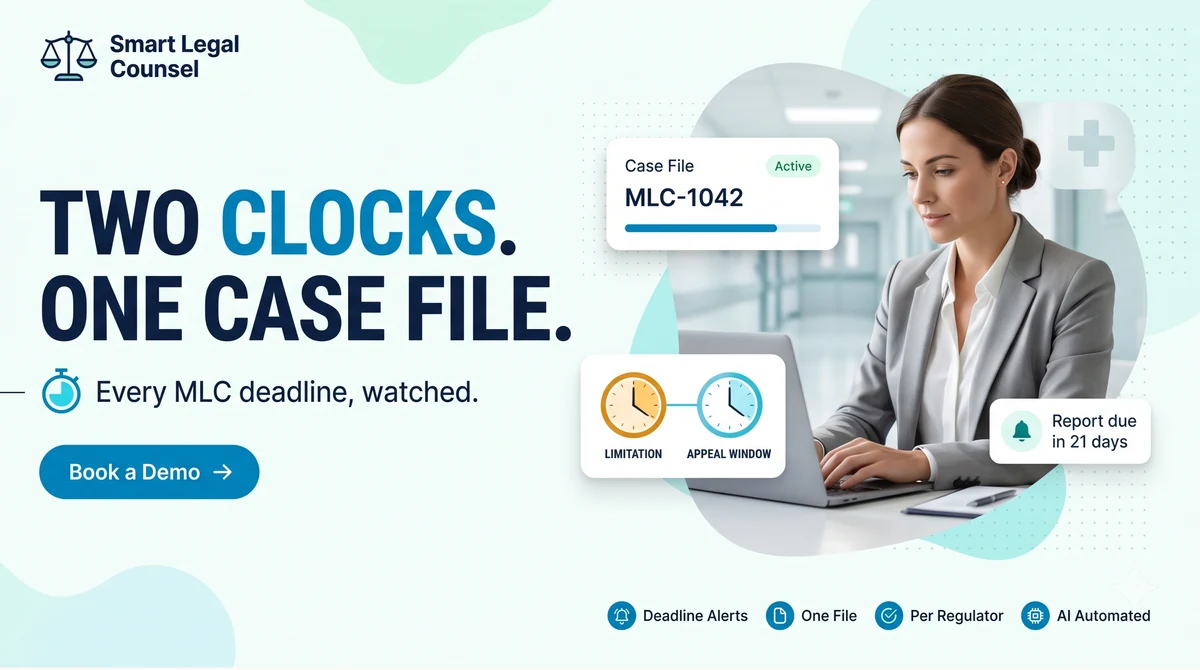
Two clocks run on every case. We watch both.

The limitation deadline is measured from the incident. The procedural deadlines, the committee's report and the appeal window, are set by the regulator's process. The two are unrelated to each other, and missing either is unrecoverable. In a spreadsheet, both depend on somebody remembering.

The limitation clock

RUNS FROM · THE INCIDENT DATE

Calculated automatically from the incident date the moment the case is opened, with the month count configurable. As it approaches, it surfaces on the dashboard on its own. Nobody has to remember it, because nobody reliably does.

The procedural clock

RUNS FROM · THE REGULATOR'S PROCESS

The report-due reminder and the appeal-window countdown are created by the workflow itself when the case enters the stage, not by a person who remembered. The appeal window defaults to 30 days from notification and is configurable per regulator.

Four alerts, on sight

  • Overdue stages
  • Appeal windows closing
  • Limitation approaching
  • Adverse findings

The MLC dashboard surfaces all four alert classes the moment it opens, across every case, every facility and every regulator.

Two deadline clocks on a Medical Liability Committee (MLC) case in Smart Legal Counsel: the limitation period counting from the incident date and the appeal window counting from the committee report notification, both watched for UAE and GCC healthcare providers
The workflow

Your workflow, enforced. Not ours, imposed.

What follows is a sample six-stage MLC workflow. Every part of it is fully customisable to your organisation's own process and each regulator's requirements: the stages and their order, the branch decisions, the mandatory fields, the day counts and the reminders. And the flow is fully AI automated: the AI Case Agent advances the case as the facts arrive, so the workflow runs itself between decisions.

  1. STAGE 01

    Complaint Received

    The complaint is registered and triaged: clinical care, consent, billing or mixed; severity up to catastrophic; criminal exposure; media risk. The limitation clock starts from the incident date.

    Limitation clock starts
  2. STAGE 02

    Pre-screening

    Jurisdiction, limitation and completeness are checked before anything is filed. A complaint that does not need a committee is closed here, on the record.

    Can close as no MLC required
  3. STAGE 03

    Under MLC

    Entering this stage raises the four standard preparation tasks by itself: collect complete medical records and imaging, obtain practitioner statements, coordinate expert opinion, prepare the bundle for the committee. The report-due reminder is set automatically.

    4 tasks + reminder, raised automatically
  4. STAGE 04 · ONLY IF APPEALED

    Higher / Supreme MLC

    The appeal-window reminder fires from the report notification date. The higher committee may confirm, amend or overturn the finding, and each outcome is recorded against the file.

    Appeal, or accept the findings
  5. STAGE 05

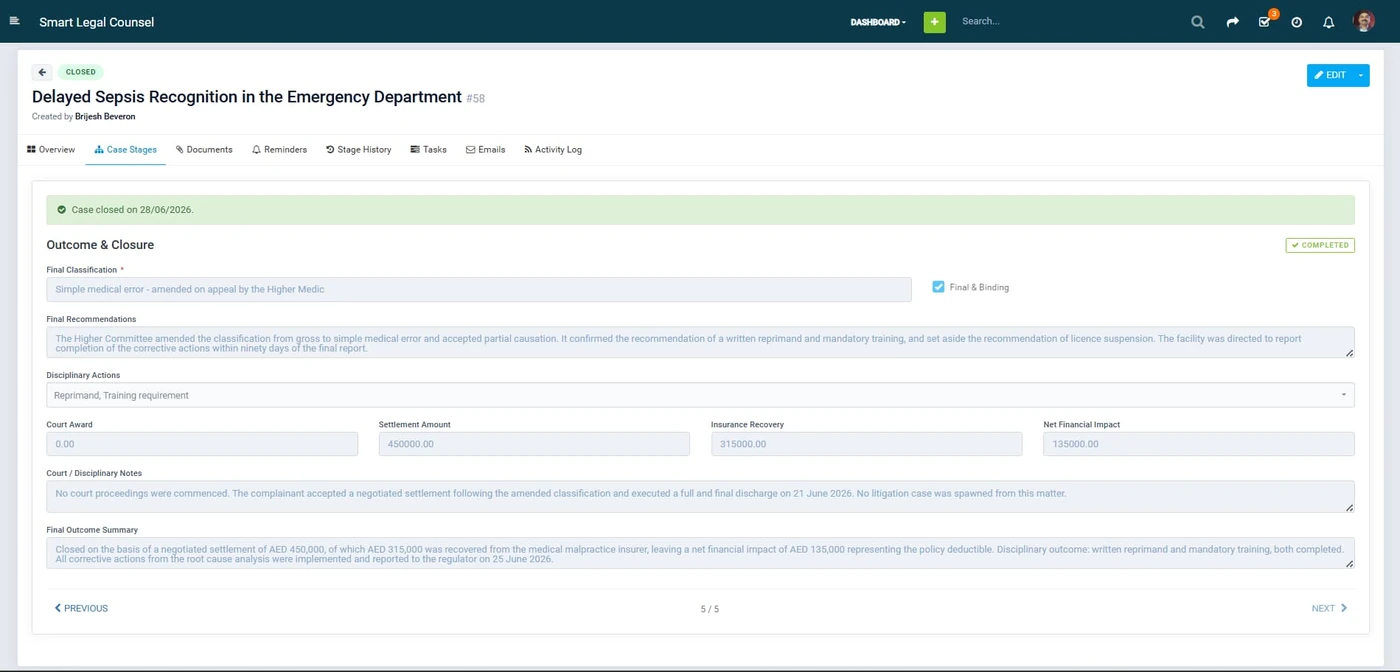
    Outcome & Closure

    Findings, classification, causation, sanctions, settlement, insurance recovery and net financial impact are recorded. A case that must go further is escalated to court, spawning a linked litigation case in the same system.

    Close, or escalate to court
  6. STAGE 06

    Closed

    The file stays complete, auditable and searchable: every stage change, every document, every deadline met, and the final position, on one record.

    Defensible, end to end

Fully customisable to your need and your workflow

This sample is a starting point, not a constraint. Your team's own process is configured into the system, per organisation and per regulator, and the AI Case Agent then automates whatever workflow you define.

Stages, order & branch decisions Mandatory fields per stage SLA day counts & deadlines Reminder offsets & notifications Per-regulator templates AI automation on your flow
The AI Case Agent

Open the case with a name. The Agent fills in the rest.

A medical liability case doesn't arrive as a form. It arrives as an email, then another email, then a PDF of the medical record, then a scanned complaint from the authority, then the committee's report, over months. With Smart Legal Counsel, you open the case with almost nothing: a title, the regulator, the facility, a file number. From then on, the case runs on its correspondence.

  • It reads every email that lands on the case, and the attachments too, including scanned PDFs and images.
  • It extracts the case facts and files them into the case record: the patient, the incident date and time, the allegation, the date the complaint was received, the practitioners named and the insurer's position, with the documents attached where they belong.
  • It writes a summary of every email, so a counsel picking up the file at month four reads the story in five minutes instead of five hours.
  • It advances the case by itself. When the facts a stage requires are finally all present, the case moves to the next stage, triggering that stage's tasks, reminders and notifications, exactly as if a lawyer had done it.
  • When it can't read something, it doesn't guess. It leaves the field blank, flags it, and alerts the case owner, by notification and by email, with a precise list of what is still missing.
Working an MLC case without and with the AI Case Agent
WithoutWith the AI Case Agent
Opening a case40+ fields typed by hand, from documentsTitle, regulator, facility, file number
A new email arrivesSomeone must read it, re-key it, file the attachmentRead, extracted, filed, summarised
Moving to the next stageSomeone must notice the file is completeThe case advances itself
Catching up on a 6-month caseRead 60 emailsRead 60 one-line summaries
Something unreadable arrivesSilently missedFlagged, blank, and escalated to the owner

The trust guarantees

It never overwrites you. The Agent fills blank fields only. If what it reads disagrees with what a human entered, it records the discrepancy for review and leaves the human's value untouched.
It knows what it doesn't know. Every extracted value carries a confidence level. Below the threshold, nothing is written. The field stays blank and a human is told.
It never invents. Values are taken only from the evidence in the correspondence, and the Agent records the evidence it relied on.
Every action is audited. What was read, what was filled, what was missing, what disagreed, and which stage the case moved from and to. In the activity log, and exportable.
A human owns the case, always. The case creator is alerted on every gap. Escalation to court is never automatic; that decision stays with a lawyer.
You can turn it off. The Agent is a setting. It can be switched off entirely.
Inside the module

The MLC module, on screen

The dashboard, the guided intake, the enforced workflow and the full case overview, as your legal team will use them.

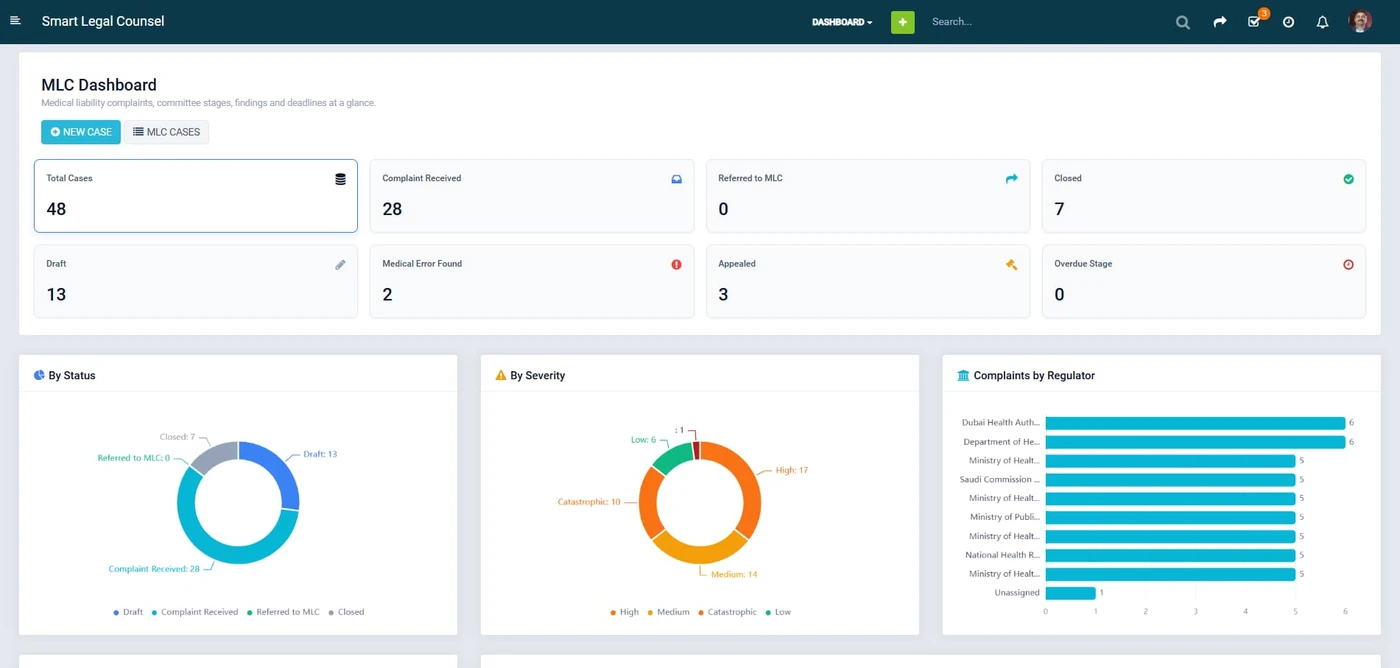
SCREEN 01 · DASHBOARD Smart Legal Counsel Medical Liability Committee (MLC) dashboard with KPI cards for open, referred and appealed cases, the four deadline alert classes, the monthly complaints trend and a cross-case timeline for a UAE healthcare group
KPI cards, the four alert classes, upcoming deadlines, the monthly complaints trend and a cross-case Gantt timeline, in one view.
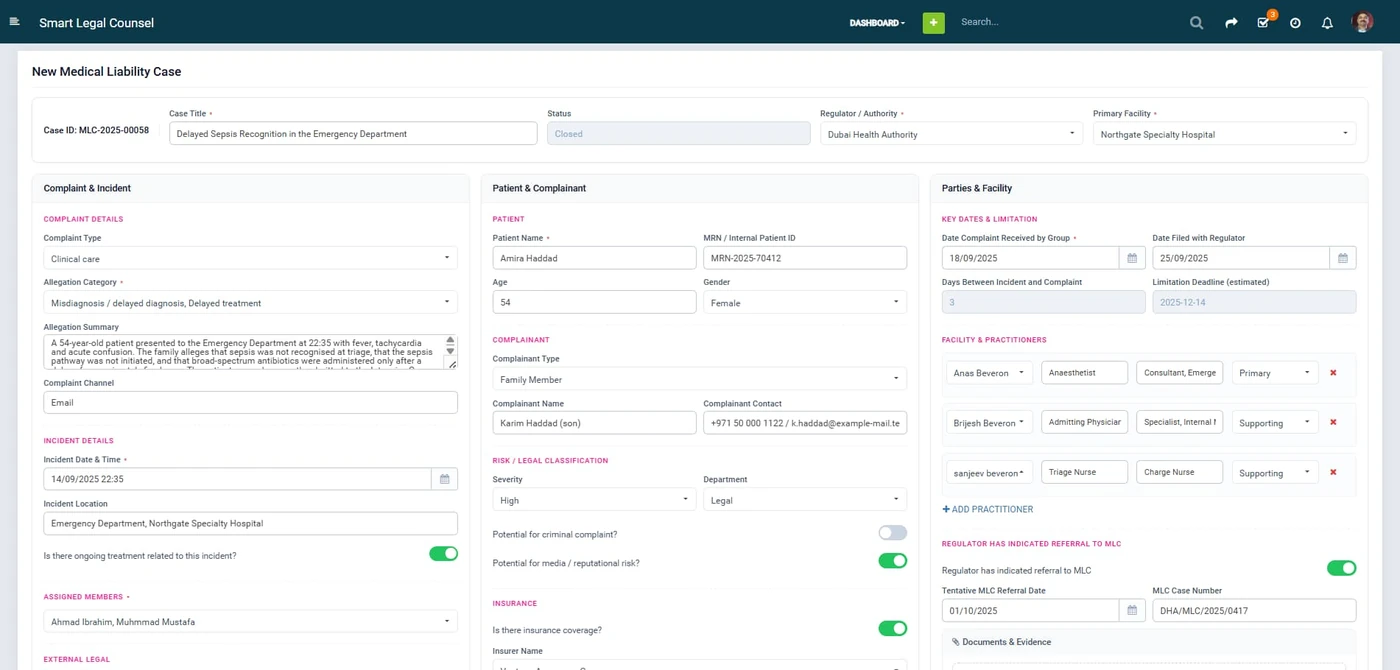
SCREEN 02 · CASE INTAKE Guided Medical Liability Committee (MLC) case intake form in Smart Legal Counsel covering complaint details, incident, patient, complainant, practitioners, risk assessment, insurance and key dates
One guided form: complaint, incident, patient, complainant, practitioners, risk assessment, insurance, key dates and evidence.
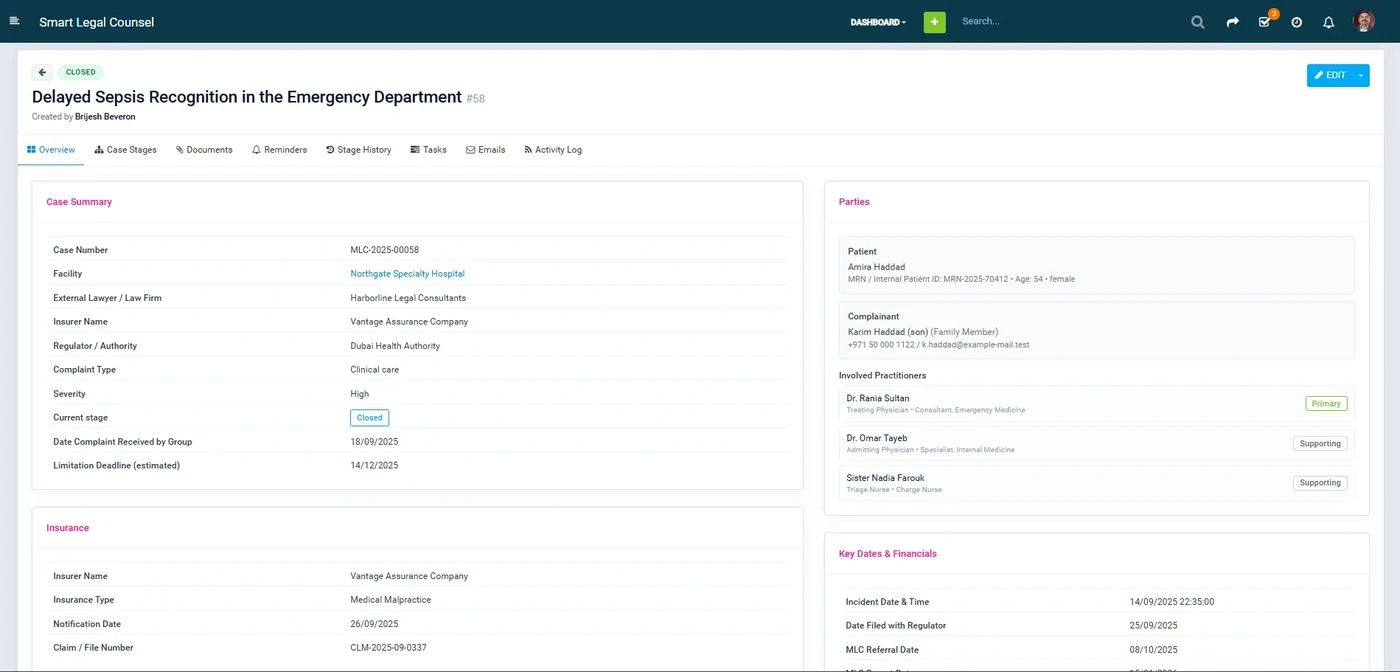
SCREEN 03 · CASE OVERVIEW Medical Liability Committee (MLC) case overview in Smart Legal Counsel showing the full case file at a glance, the parties, the current stage, deadlines, documents and the activity log for a UAE hospital legal and risk team
The full case file at a glance: the parties, the current stage, deadlines, documents, tasks and the activity log, on one record.
SCREEN 04 · WORKFLOW The six-stage Medical Liability Committee (MLC) workflow in Smart Legal Counsel with guarded stage transitions, stage history and preparation tasks raised automatically under the case's regulator
The six stages with mandatory fields, guarded transitions, branch decisions and the full stage history log.
One file

The file that defends itself

Complaint, patient, complainant, practitioners, department, specialty, allegations, incident, insurer, records, statements, expert opinion, the committee's report, the appeal, the sanctions, the money. Every touch is on the activity log. When you have to defend the file, the file defends itself.

Guided intake

Complaint type, channel and narrative; incident date, time and location; patient and complainant; facility, department, specialty and named practitioners; risk assessment with severity up to catastrophic, criminal exposure and media risk; insurer, policy and notification; key dates and limitation; documents and internal notes. Save as draft or submit.

Allegations & severity

A structured allegation taxonomy, misdiagnosis or delayed diagnosis, surgical complication, medication error, obstetric event, ICU event, consent failure, delayed treatment, billing, other, with a four-point severity scale from low to catastrophic.

Findings record

Error found, classification as simple or gross, causation, recommended sanctions, report dates, the higher committee's confirm, amend or overturn outcome, final classification, root-cause notes, counsel's analysis and the insurer's position.

Appeal record

Adverse-finding flag, notification date, the appeal window in days, the appeal decision and its rationale, filing date, authority reference, higher-committee status and the final binding outcome.

Outcomes & the money

Disciplinary outcomes from reprimand to licence suspension and facility fines; court award, settlement amount, insurance recovery and net financial impact, with a link to the spawned litigation case.

Patient data, protected

Clinical and medical-record documents restricted to authorised staff, a de-identify toggle for patient data, role-based access and an activity log of every view and edit, with cloud or on-premise deployment.

CASE WORKSPACE · Overview · Case Stages · Documents · Reminders · Stage History · Tasks · Emails · Activity Log

Built for this region

DHA. DOH. MOHAP. And six more, configured out of the box.

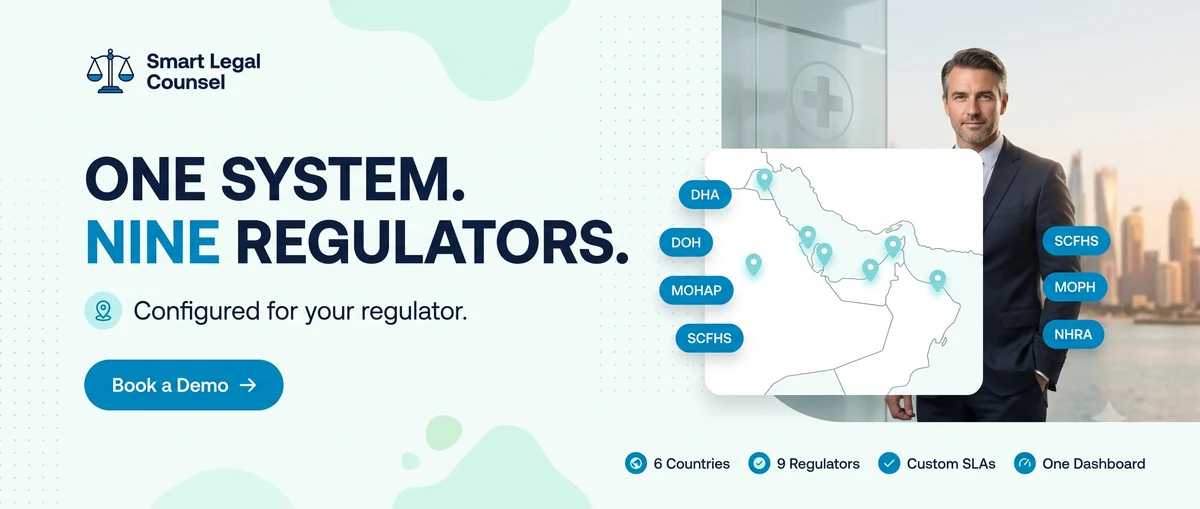
Nine GCC health regulators are pre-loaded, because DHA does not run its process the way MOPH Qatar does. Stage templates, service-level day counts, reminder offsets and mandatory intake fields are configurable per regulator, with a global default. A healthcare group with facilities across the GCC runs every jurisdiction in one system.

DHADubai Health AuthorityDubai · UAE
DOHDepartment of Health – Abu DhabiAbu Dhabi · UAE
MOHAPMinistry of Health and PreventionUAE · Federal
SCFHSSaudi Commission for Health SpecialtiesSaudi Arabia
MOHMinistry of HealthSaudi Arabia
MOPHMinistry of Public HealthQatar
NHRANational Health Regulatory AuthorityBahrain
MOHMinistry of HealthKuwait
MOHMinistry of HealthOman

Everything here is customisable as per your need: the stage template and stage names, service-level day counts, reminder offsets and mandatory-field rules are all configured to your organisation's own process under each regulator. Procedural requirements should always be verified with your regulator and counsel.

Nine GCC health regulators, including DHA, DOH, MOHAP, SCFHS, MOPH and NHRA, pre-configured in Smart Legal Counsel for Medical Liability Committee case management across the UAE, Saudi Arabia, Qatar, Bahrain, Kuwait and Oman
Case study

One complaint, seven months, zero missed deadlines

A private hospital group in the UAE, running several facilities with a three-person legal and risk team. What follows is how a typical surgical-complication complaint runs through Smart Legal Counsel, from the authority's first email to closure.

  1. DAY 0

    The complaint arrives by email

    The regulator forwards a patient complaint alleging a surgical complication. Counsel opens the case with a title, the regulator, the facility and a file number. The AI Case Agent reads the email and its scanned attachment, fills the complaint details, the incident date and the named practitioners, and the limitation clock starts from the incident date.

  2. DAY 6

    Pre-screening confirms it is real

    Jurisdiction and limitation check out; the documentation is incomplete. The Agent flags the missing consent form and alerts the case owner. Risk assessment: severity high, no criminal exposure, insurer notified the same day, its position recorded on the file.

  3. DAY 21

    Under MLC, the bundle builds itself a task at a time

    The case enters Under MLC and the four preparation tasks are raised automatically: complete medical records and imaging, practitioner statements, expert opinion, and the committee bundle. Clinical documents stay restricted to authorised staff, with patient data de-identified for wider review. The report-due reminder is already set.

  4. DAY 140

    The committee finds a simple error

    The report lands on the case by email; the Agent files it and summarises it. The findings record captures: error found, classified simple, causation partial, a training recommendation for one practitioner. The finding is adverse, so the appeal-window countdown starts from the notification date and appears on the dashboard.

  5. DAY 158

    The appeal decision is made with 12 days to spare

    Counsel, the medical director and the insurer review the file, which by now reads as sixty one-line summaries instead of sixty emails. The decision: appeal on causation. The appeal is filed inside the window, with the rationale and authority reference on the record.

  6. DAY 209

    Amended, closed, and reported to the board

    The higher committee amends the finding on causation. The file closes with the final classification, the training requirement logged as the disciplinary outcome, the insurance position settled, and the net financial impact recorded. The General Counsel's board line takes one screen, not one week.

Pricing

Choose the Right Edition for Your Legal Department

Three flexible editions designed for in-house legal teams of every size.

Smart Legal Counsel Basic Edition for a small hospital or clinic in-house legal team running Medical Liability Committee (MLC) cases with core modules and basic AI automation
Basic Edition

Small Legal Counsel

For Small Legal Teams, Up to 5 Users. Legal Counsel Modules included.

  • Legal Counsel Modules
  • AI Legal Process Automation (Basic)
Try Now
Smart Legal Counsel Premium Edition: full corporate legal platform with Medical Liability Committee (MLC) cases, court escalation and Microsoft Teams integration for a large healthcare group legal department in the UAE and GCC
Premium Edition

Large Corporate Legal Counsel

For Large Enterprise Legal Departments, Unlimited Users. Full platform access.

  • Everything in Standard
  • Internal Business Portal
  • Advanced Automation
  • Microsoft Teams Integration
Try Now
FAQ

Medical liability case questions, answered

What is medical negligence case management software?
Medical negligence case management software is a system that manages a healthcare provider's medical negligence and liability cases from the day a patient complaint arrives to the day the case closes, through pre-screening, the Medical Liability Committee's review, any appeal to a higher committee, and any court action. It is built for the hospital or clinic's own in-house legal and risk team, not for a claimant's law firm. Smart Legal Counsel by Beveron Technologies gives that team one case file per complaint, a fully customisable six-stage workflow, automatic deadline tracking for the limitation period and the appeal window, and an AI Case Agent that reads case correspondence and keeps the file current, across hospitals and clinics in the UAE and GCC.
What is Medical Liability Committee (MLC) case management software?
Medical Liability Committee (MLC) case management software is a system that manages a healthcare provider's medical liability cases from the day a patient complaint arrives to the day the case closes, through pre-screening, the committee's review, any appeal to a higher committee, and any court action. Smart Legal Counsel by Beveron Technologies gives hospital and healthcare group legal teams one case file per complaint, a guided six-stage workflow, automatic deadline tracking for the limitation period and the appeal window, and an AI Case Agent that reads case correspondence and keeps the file current.
What does the MLC workflow in Smart Legal Counsel look like?
The workflow runs through six stages in a fixed order: Complaint Received, Pre-screening, Under MLC, Higher or Supreme MLC (only if the finding is appealed), Outcome and Closure, and Closed. Each stage has mandatory fields the case cannot advance without, and each stage change is logged with who moved it, when, and why. Pre-screening can close a case as no MLC required, and Outcome and Closure can escalate the case to court, which creates a linked litigation case in the same system.
How does the software track the limitation period and the appeal window?
Two separate clocks are tracked on every case. The limitation deadline is calculated automatically from the incident date, and the procedural deadlines, such as the committee report due date and the appeal window after an adverse finding, are created by the workflow itself when the case enters the relevant stage. The dashboard surfaces four alert classes on sight: overdue stages, appeal windows closing, limitation approaching, and adverse findings. Deadline day counts and reminder offsets are configurable per regulator.
What does the AI Case Agent do on a medical liability case?
The AI Case Agent reads every email that lands on the case, including attachments such as scanned PDFs and images. It extracts the case facts, files them into the case record, attaches the documents where they belong, and writes a one-line summary of every email. When the facts a stage requires are all present, it advances the case to the next stage, triggering that stage's tasks, reminders and notifications. When it cannot read something, it does not guess: it leaves the field blank, flags it, and alerts the case owner with a list of what is still missing.
Can the AI Case Agent overwrite information a lawyer has already entered?
No. The AI Case Agent fills blank fields only. If what it reads in the correspondence disagrees with a value a person has already entered, it records the discrepancy for review and leaves the human's value untouched. Every extracted value carries a confidence level, and below the threshold nothing is written. Every action the Agent takes is recorded in the case activity log, and the Agent can be switched off entirely in settings.
How is patient data protected inside an MLC case file?
Clinical and medical-record documents on a case are restricted to authorised staff through role-based access, and patient data can be de-identified with a toggle so the case can be worked on without exposing patient identity. Every view and edit is recorded in the activity log, data is encrypted in transit and at rest, and the platform can be deployed on-premise on the hospital's own servers where data residency policy requires it.
Which health regulators does the MLC module support?
Nine GCC health regulators are pre-loaded: Dubai Health Authority (DHA), Department of Health Abu Dhabi (DOH), the UAE Ministry of Health and Prevention (MOHAP), the Saudi Commission for Health Specialties (SCFHS), the Saudi Ministry of Health, Qatar's Ministry of Public Health (MOPH), Kuwait's Ministry of Health, Bahrain's National Health Regulatory Authority (NHRA), and Oman's Ministry of Health. Stage templates, service-level day counts, reminder offsets and mandatory intake fields are configurable per regulator, with a global default.
What happens when an MLC case escalates to court?
From the Outcome and Closure stage, the case can be escalated to court, which creates a linked litigation case in the same Smart Legal Counsel platform rather than starting over in another system. The litigation case carries the full history of the MLC proceedings, and the financial outcome record tracks the court award, settlement amount, insurance recovery and net financial impact. Escalation is never automatic; that decision always stays with a lawyer.
Can the system record committee findings, error classification and sanctions?
Yes. The findings record captures whether a medical error was found, its classification as simple or gross, causation, recommended sanctions, the report date, the higher committee's review outcome of confirm, amend or overturn, the final classification, root-cause analysis notes, the legal counsel's analysis and the insurer's position. Disciplinary outcomes covering reprimand, training requirements, temporary or permanent licence suspension, facility fines or no action are recorded on the same file.
Does it work for a healthcare group with facilities in more than one GCC country?
Yes. A healthcare group running hospitals and clinics across the UAE, Saudi Arabia, Qatar, Bahrain, Kuwait and Oman can run all of its medical liability cases in one system, with each case following the stage template, deadlines and mandatory fields of its own regulator. Group legal leadership gets one dashboard of exposure across every facility and jurisdiction, instead of a separate spreadsheet per country.
Can Smart Legal Counsel be hosted on our own hospital servers?
Yes. Smart Legal Counsel supports both cloud hosting and on-premise deployment on the hospital's own servers, so a healthcare provider can choose the model that fits its data-residency and IT policy for patient information. It also integrates with Active Directory single sign-on, Microsoft Office, Outlook, SharePoint and Teams.
Is the MLC module a separate product or part of Smart Legal Counsel?
The Medical Liability Committee case module is part of Smart Legal Counsel, Beveron's corporate legal case management platform for in-house legal departments. That means the same platform also runs the legal team's litigation, contracts and e-signature, legal notices, risk register, licences and renewals, recoveries and intellectual property, so an MLC case that becomes a court case, a settlement or an insurance recovery never leaves the system of record. See also our legal software for healthcare providers.
Talk to Our Team

See your own MLC workflow, not a canned tour

Tell us about your hospital group or clinic network and which regulators you answer to. We will walk the Medical Liability Committee module on your own workflow, from intake and the two clocks to findings, appeal and court escalation.

  • Serving 24 countries across the GCC, India & beyond
  • Trusted by 10,000+ legal professionals
  • Cloud or on-premise on your own servers

Request a Demo

  • United Arab Emirates
  • Saudi Arabia
  • Qatar
  • Bahrain
  • Kuwait
  • Oman
  • Algeria
  • Australia
  • Bangladesh
  • Canada
  • Egypt
  • France
  • Germany
  • Ghana
  • India
  • Indonesia
  • Iraq
  • Italy
  • Ivory Coast
  • Jordan
  • Kenya
  • Lebanon
  • Malaysia
  • Morocco
  • Netherlands
  • Nigeria
  • Pakistan
  • Philippines
  • Rwanda
  • Singapore
  • South Africa
  • Spain
  • Sri Lanka
  • Sudan
  • Tanzania
  • Thailand
  • Turkey
  • United Kingdom
  • United States
  • Other

Insights

Latest articles, guides, and resources for corporate legal departments

View More Articles